The Complete Answer: What Are Berber Crafts?
Berber crafts are handmade items created by the Amazigh people of North Africa, encompassing textiles, jewelry, pottery, and more, with traditions dating back over 2,000 years. Berber crafts represent one of the world’s oldest living artisanal traditions, spanning more than 2,000 years across North Africa’s Atlas Mountains and Sahara regions. Handed down through generations of Amazigh (Berber) women and men, these creations — from the famously geometric Beni Ourain rugs to intricate silver jewelry — have become global design icons featured in luxury interiors, fashion collections, and museum exhibitions worldwide. Yet beyond their aesthetic appeal lies a complex cultural language of symbols, tribal identity, and centuries-old techniques that modern buyers often overlook.This guide provides a definitive, practical deep-dive into what these crafts are, how to authenticate them, what they cost, and how to care for them.
Key Takeaways
- Authentic pieces are cultural expressions of Amazigh identity, not generic “Moroccan souvenirs” — each carries tribal symbols, regional markers, and a weaving or metalworking tradition dating back over 2,000 years.
- The most valuable items — including Beni Ourain rugs and silver jewelry — are handmade using pre-industrial techniques; machine-made imitations flood tourist markets and can be identified by several concrete markers.
- Prices for genuine pieces range widely: handwoven rugs typically cost $200–$3,000 depending on wool quality, knot density, and age, while vintage tribal jewelry averages $150–$1,500.
- Ethical sourcing matters: buying from women’s cooperatives and fair-trade certified sellers ensures that 60–80% of the purchase price reaches the artisan, versus 10–15% in tourist souks.
- Proper care extends the life of these pieces dramatically — natural wool rugs require specific cleaning methods, and silver jewelry needs controlled humidity storage to prevent tarnishing.
The Definition: More Than Just Souvenirs
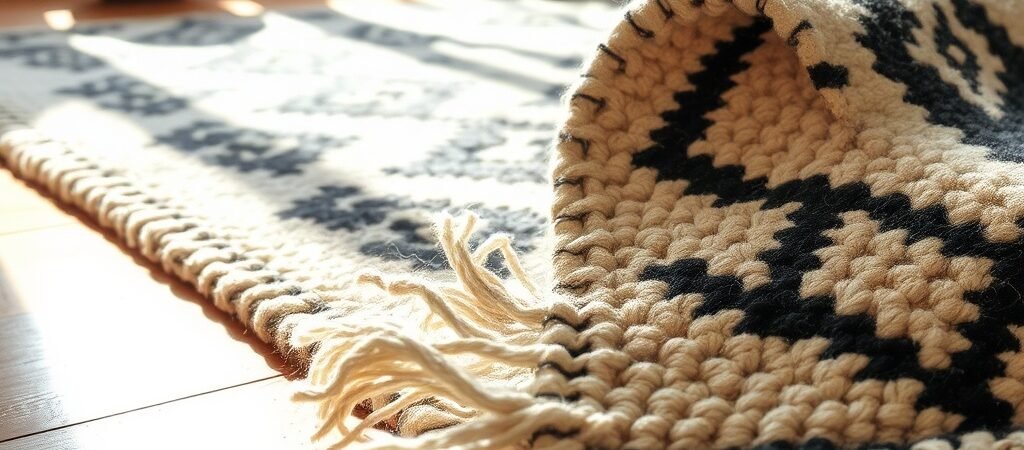
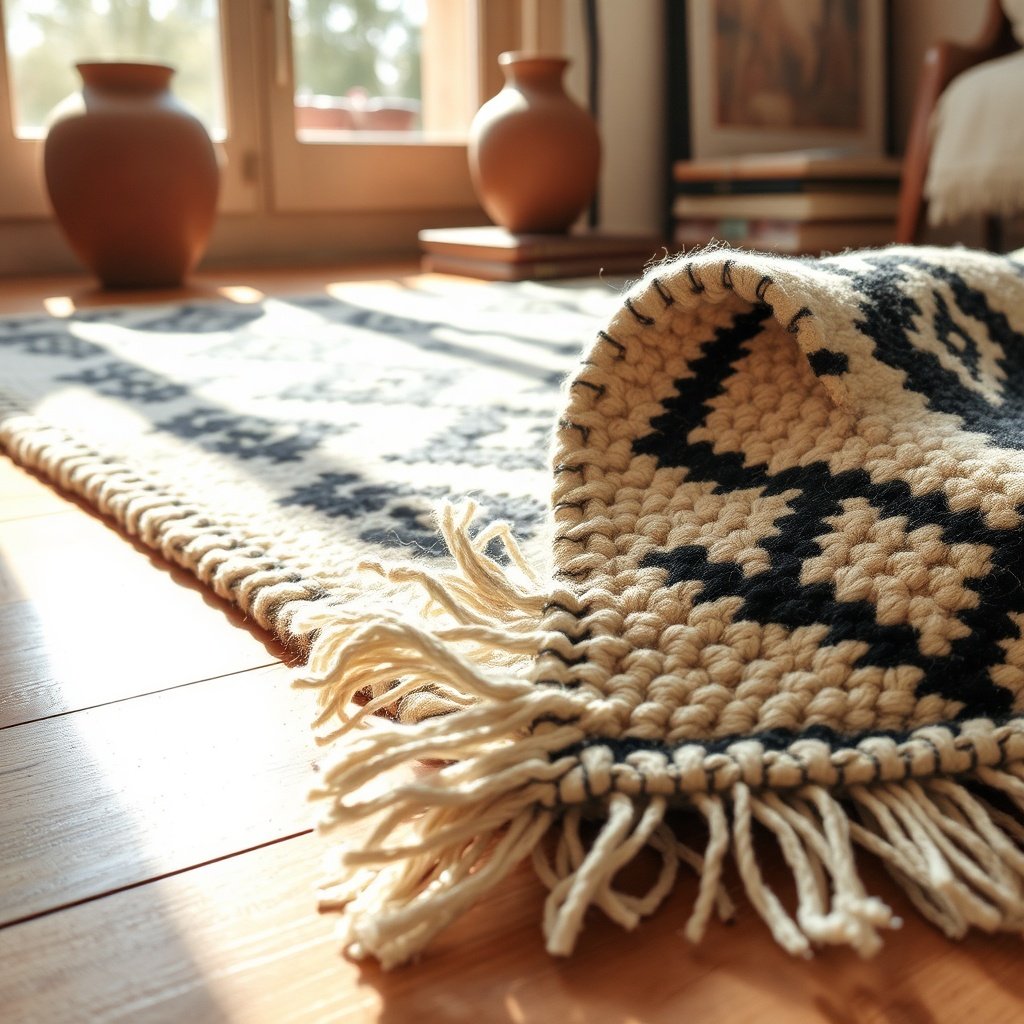
An evocative close-up highlighting the texture and design of a genuine Berber rug, symbolizing centuries of Amazigh weaving tradition.
Definition: Amazigh culture — The indigenous North African culture of the Berber people, an ethnic group estimated at 25–33 million across Morocco, Algeria, Tunisia, and Libya, whose distinct language (Tamazight) and artisanal traditions predate Arab influence by millennia.
Distinguishing authentic pieces from tourist-grade imitations requires understanding their core characteristics: hand-spun natural wool or camel hair, vegetable or natural mineral dyes, and construction techniques (knotting, weaving, soldering) that predate industrial machinery. Genuine items also carry the maker’s cultural signature — Amazigh women traditionally weave their personal symbols into rugs, making each piece a unique autobiographical record.
The Cultural DNA: Amazigh Identity in Every Stitch
The craft traditions are inseparable from Amazigh identity. For centuries, Berber women were the primary weavers, passing patterns and symbolism orally from mother to daughter. The geometric motifs are not decorative accidents — the diamond represents the female eye warding off evil, the zigzag line symbolizes water and life, and the X-shape marks tribal boundaries. These Berber symbols and patterns encode a visual language that remains essential to appreciating (and accurately pricing) any piece.
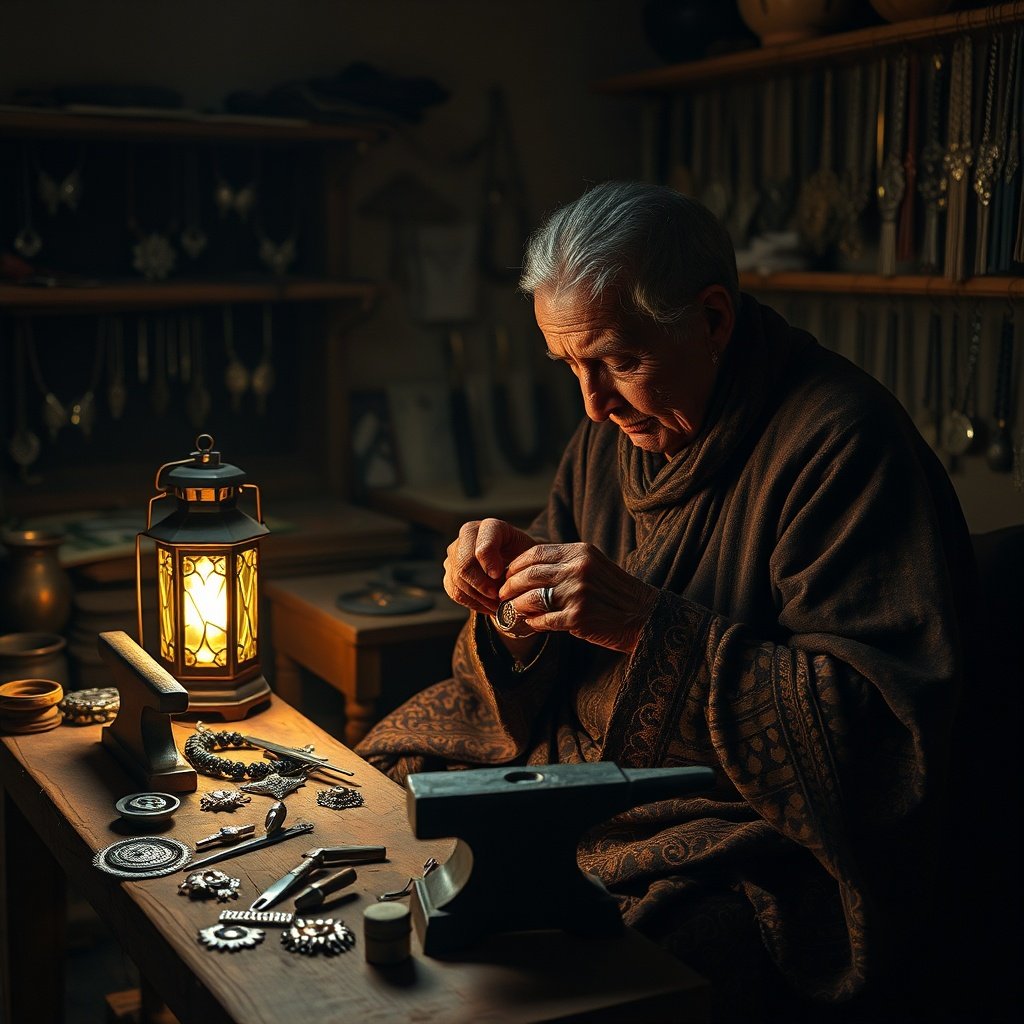
A poignant portrayal of a Berber jeweler at work, emphasizing the human touch behind each piece of traditional Amazigh silver jewelry.
Why They Matter Globally
These crafts have moved from ethnographic curiosities to high-design staples. Major auction houses like Christie’s and Sotheby’s regularly feature vintage Berber rugs with hammer prices exceeding $10,000, and fashion houses including Dior and Hermès have incorporated Amazigh weaving techniques into collections — a trend that has increased global demand while simultaneously raising concerns about cultural appropriation and artisan exploitation. Within the broader Moroccan handicrafts sector, which employs over 2.3 million artisans and generates roughly $1.2 billion in annual exports, Berber textiles and jewelry command the highest premiums.
Quick Answer: Why do Berber crafts command such high prices internationally? Because each piece is a handcrafted cultural document — a Beni Ourain rug takes 3–6 months of daily weaving, and its wool comes from a specific Atlas sheep breed with high lanolin content. Combined with rising demand from luxury interiors and fashion, authentic pieces now sell for $300 to over $10,000 at auction.
The Living History: Berber Craft Traditions Through the Ages
The history of Berber crafts is a story of adaptation and survival. Archaeological evidence — including textile fragments and jewelry found in Saharan rock shelters — dates Amazigh craft production to at least 800 BCE, making it one of the oldest continuous artisanal traditions in the Mediterranean basin.
Pre-Islamic Origins and Symbolic Language
The earliest Berber crafts served practical and spiritual purposes: rugs insulated tents against mountain cold, jewelry functioned as portable wealth and protection amulets, and pottery stored grain and water. The symbolic vocabulary — lozenges, eyes, hands (khamsa), and cross motifs — predates Islamic influence, rooted in pre-monotheistic Amazigh cosmology. These symbols persist today, making modern pieces direct descendants of a 3,000-year-old visual tradition.
The Evolution Through Trade Routes
From the 8th century onward, trans-Saharan trade routes transformed Berber crafts. Caravans brought silver from Timbuktu, coral from Mediterranean ports, and indigo from West Africa — materials that became signature elements of Berber jewelry and textiles. This period also introduced Islamic geometric influence, which blended with indigenous Amazigh motifs to create the distinctive hybrid aesthetic seen in Moroccan rugs and metalwork today.
Regional Variations Across North Africa
Each Amazigh region developed distinct craft identities: the Middle Atlas is home to the globally famous Beni Ourain rugs (cream and black geometric patterns), the High Atlas produces the colorful Azilal rugs, the Anti-Atlas specializes in woven cotton and silk pieces, and the Sahara’s Tuareg people are renowned for silver cross jewelry and leatherwork. Understanding these regional differences is critical for authentication — a rug claiming to be “Beni Ourain” but featuring Azilal’s characteristic red dyes is a red flag.
Quick Answer: Where do the main Berber craft traditions come from? The Middle Atlas produces the minimalist cream-and-black Beni Ourain rugs, the High Atlas yields the bold Azilal rugs, and the Sahara’s Tuareg people craft the famous silver cross jewelry. Each region’s distinct materials, dyes, and motifs make geographic provenance a primary authentication tool.
The Craft Spectrum: Types and Hallmarks
Berber crafts span five primary categories, each with distinct materials, techniques, and market values. This comparative framework helps identify and value each type.
| Craft Type | Primary Materials | Key Characteristics | Typical Price Range | Authentication Markers | |—|—|—|—|—| | Beni Ourain Rugs | Hand-spun sheep wool (natural cream/black) | Minimalist geometric diamonds, 80–120 knots per square inch, plush 1–2 cm pile | $200–$3,000 (vintage up to $10,000+) | Asymmetrical edges, slight color variation, hand-knotted fringe | | Azilal Rugs | Wool with cotton accents | Bold colors (red, orange, blue), abstract symbols, thinner pile | $150–$1,800 | Irregular patterns, visible hand-spun yarn, wool backing | | Boucherouite Rugs | Recycled fabric strips | Chaotic, colorful patchwork, flat-weave or knotted | $100–$800 | Visible fabric knots, uneven surface, no two alike | | Berber Silver Jewelry | 80–95% silver, amber, coral | Geometric pendants, triangular motifs, heavy filigree | $50–$1,500 per piece | Stamped or hand-engraved marks, natural patina | | Amazigh Pottery | Hand-coiled clay, mineral pigments | Terracotta tones, incised geometric patterns, no glaze | $20–$300 | Fingerprint ridges, uneven walls, matte finish |
Textiles and Rugs: The Global Icons
Berber rugs are the most commercially significant craft category, with Beni Ourain rugs alone generating an estimated $50 million in annual global sales. A genuine Beni Ourain requires 3–6 months of daily weaving by a single artisan, with knot counts reaching 80–120 per square inch. The wool comes from a specific breed of Atlas sheep, famed for its high lanolin content, which gives authentic rugs their characteristic softness and natural stain resistance. This traditional Berber carpet weaving remains a female-dominated craft, passed down through matrilineal lines.
Jewelry and Metalwork: Silver, Amber, and Symbol
Traditional Berber jewelry is predominantly silver — historically, gold was considered impure in Amazigh culture. Artisans use 80–95% pure silver, often recycled from old coins and family heirlooms. Signature pieces include the tizerzai (large triangular pendant), the tabzimt (fibula brooch), and the Tuareg cross. Amber and red coral beads are common additions, with amber believed to carry healing properties. These traditional Berber jewelry pieces serve as both adornment and portable wealth.
Pottery, Leather, and Wood: The Functional Arts
Less commercially hyped but equally significant are Berber pottery, Berber leatherwork (including the famous Babouche slippers and water bags), and carved wood items. Traditional pottery is hand-coiled — never wheel-thrown — and fired in open kilns, producing distinctive terracotta tones with incised geometric patterns. These functional crafts remain central to daily Amazigh life and offer more accessible entry points for collectors on a budget.
Quick Answer: What are the five main types of Berber crafts? Beni Ourain rugs (cream-and-black geometric wool), Azilal rugs (bold multicolor), Boucherouite rugs (recycled fabric patchwork), silver jewelry (geometric pendants with amber and coral), and hand-coiled pottery. Each type has distinct materials, price ranges, and authentication markers detailed in the table above.
How to Identify Authentic Pieces
Authentication is the single most important skill for anyone buying Berber crafts, given the proliferation of machine-made imitations. This systematic verification protocol applies to rugs, jewelry, and other craft categories.
Visual and Tactile Markers of Authenticity
Authentic pieces exhibit consistent physical markers. For rugs: examine the fringe — hand-knotted fringes are irregular and individually tied, never perfectly uniform. Check the edges for asymmetry, and flip the rug to verify a wool backing with visible hand-knots rather than a glued canvas or synthetic mesh. For jewelry: look for stamped or hand-engraved marks, natural patina on 80–95% silver, and handmade clasps; machine-made pieces show uniform cast details and a shiny, uniform surface. For pottery: check for fingerprint ridges, uneven walls, and a matte finish. For leather goods: look for irregular stitching and natural dye variations. Across all categories, remember that slight imperfections are a hallmark of authenticity — machine-made imitations are too uniform, too symmetrical, and too flawless.
Conclusion
Berber crafts represent far more than decorative objects — they are living documents of Amazigh identity, carrying centuries of matrilineal knowledge, symbolic language, and artisanal mastery in every hand-knotted fringe and hand-stamped silver mark. From the globally celebrated Beni Ourain rugs with their 80–120 knots per square inch to the humble hand-coiled pottery that still anchors daily Amazigh life, each piece tells a story of cultural resilience. However, the proliferation of machine-made imitations threatens both the authenticity of the market and the livelihoods of the women artisans who sustain these traditions. As a buyer, you hold the power to preserve this heritage. Whether you are drawn to the plush minimalism of a Beni Ourain, the vibrant chaos of a Boucherouite, or the symbolic weight of a tizerzai pendant, commit to learning the authentication markers outlined above and purchase from reputable cooperatives or direct artisan partnerships. By investing in genuine Berber crafts, you are not just acquiring a beautiful heirloom — you are actively sustaining an ancient cultural legacy for generations to come.
FAQ
1. How can I tell if a Beni Ourain rug is authentic and not a machine-made imitation?
Authentic Beni Ourain rugs exhibit several unmistakable markers. First, examine the fringe — hand-knotted fringes are irregular, individually tied, and never perfectly uniform. Second, check the edges: genuine rugs have asymmetrical edges rather than perfectly straight machine-cut lines. Third, look for slight color variation in the natural cream and black wool, which indicates hand-spun yarn from Atlas sheep. Fourth, flip the rug over — authentic pieces show visible hand-knots and a wool backing, not a glued canvas or synthetic mesh. Finally, consider the weight and texture: authentic rugs are plush with a 1–2 cm pile and contain high lanolin from the specific Atlas sheep breed, giving them a soft, slightly waxy feel. Machine-made reproductions feel flat, uniform, and often use synthetic fibers that lack this natural softness.
2. Why is Berber jewelry traditionally made of silver rather than gold?
In Amazigh culture, gold has historically been considered impure. This belief stems from a combination of Islamic influence (which discourages men from wearing gold) and indigenous Amazigh values that associated silver with purity, protection, and spiritual clarity. Silver was also more practical: it was readily available through trade, easily recycled from old coins and family heirlooms, and could be worked with simpler tools. Authentic Berber silver jewelry uses 80–95% pure silver, which is softer and develops a natural patina over time. This patina is actually a sign of authenticity — genuine pieces darken and age gracefully, while silver-plated imitations will flake or show base metal underneath.
3. What is the difference between a Boucherouite rug and other Berber rugs?
The Boucherouite is the most distinctive and often misunderstood Berber rug type. Unlike Beni Ourain or Azilal rugs, which are woven from sheep wool, Boucherouite rugs are made from recycled fabric strips — old clothing, blankets, and textile scraps. This makes them the most sustainable and affordable Berber craft, typically ranging from $100 to $800. They feature chaotic, colorful patchwork designs with no two pieces alike, and can be either flat-woven or knotted. Historically, Boucherouites were created by women who lacked access to sufficient wool, transforming scarcity into artistic innovation. Because of their irregular patterns and visible fabric knots, they are actually harder to counterfeit than wool rugs, making them an excellent entry point for first-time collectors.
4. Why are authentic Beni Ourain rugs so expensive, and is the price justified?
A genuine Beni Ourain rug requires 3–6 months of daily weaving by a single artisan. The wool comes from a specific breed of Atlas sheep with high lanolin content, which is naturally stain-resistant and exceptionally soft. With knot counts reaching 80–120 per square inch, a single rug can contain hundreds of thousands of individual knots, each tied by hand. The $200–$3,000 price range (with vintage pieces exceeding $10,000) reflects thousands of hours of labor, the cost of quality materials, and the skill passed down through matrilineal lines. When you divide the price by the hours of work, artisans often earn below minimum wage — so the price is not just justified; it is arguably still undervaluing the craft. Buying authentic rugs directly supports female artisans and preserves a weaving tradition that generates an estimated $50 million annually in global sales.
5. What are the most accessible Berber crafts for a beginner collector on a budget?
For budget-conscious collectors, Amazigh pottery is the most accessible entry point, with pieces ranging from $20 to $300. Hand-coiled, fired in open kilns, and decorated with mineral pigments, authentic pottery displays fingerprint ridges, uneven walls, and a matte finish — all signs of genuine craftsmanship. Boucherouite rugs ($100–$800) are also excellent beginner purchases, as their recycled-fabric construction makes them harder to counterfeit. Small Berber silver jewelry pieces, such as a simple tabzimt brooch or a modest geometric pendant, start around $50 and offer a wearable connection to Amazigh heritage. For any of these, always verify the authentication markers — stamped or hand-engraved marks on silver, fingerprint ridges on pottery, and visible fabric knots on rugs — and purchase from reputable cooperatives or artisans you can contact directly.