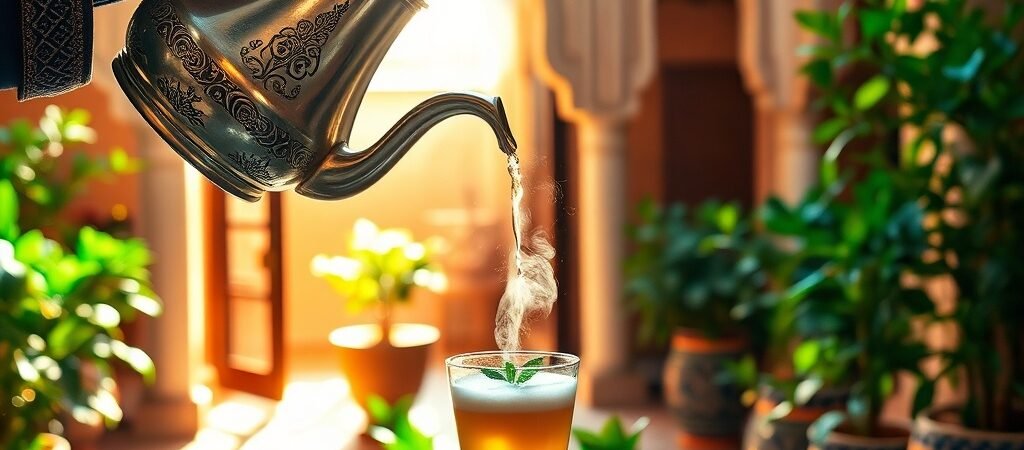
The scent of fresh mint and gunpowder tea curling through a Marrakech medina is the first thing you notice — before the call to prayer, before the spice stalls. Moroccan tea time is not a beverage break; it’s a cultural institution that has defined hospitality in this North African nation for over 170 years. At its core, Moroccan tea time is a twice-daily ritual where Chinese gunpowder green tea is boiled with sugar, infused with fresh spearmint, and poured theatrically from a height of 12 inches into ornate tea glasses. Refusing a cup is a breach of tea etiquette. Accepting three glasses signals trust and friendship. This guide covers the definitive answer, the ritual mechanics, the ingredients, a foolproof hosting method, global comparisons, and where to experience it in 2026.
Key Takeaways
- Moroccan tea time (Atay) is a daily ritual of hospitality, not just a drink — refusing tea is considered a breach of etiquette
- The tea is always gunpowder green tea, fresh mint, and sugar — typically 2-3 sugar cubes per glass
- The signature high pour from 12 inches (30 cm) aerates the tea and creates a foam cap (raqwa) that signals quality
- Guests are served a minimum of three glasses, each with a different character: “bitter as life, sweet as love, gentle as death”
- Morocco consumes roughly 4.5 kg of green tea per capita annually — among the highest in the world
The Complete Answer: What Is Moroccan Tea Time?
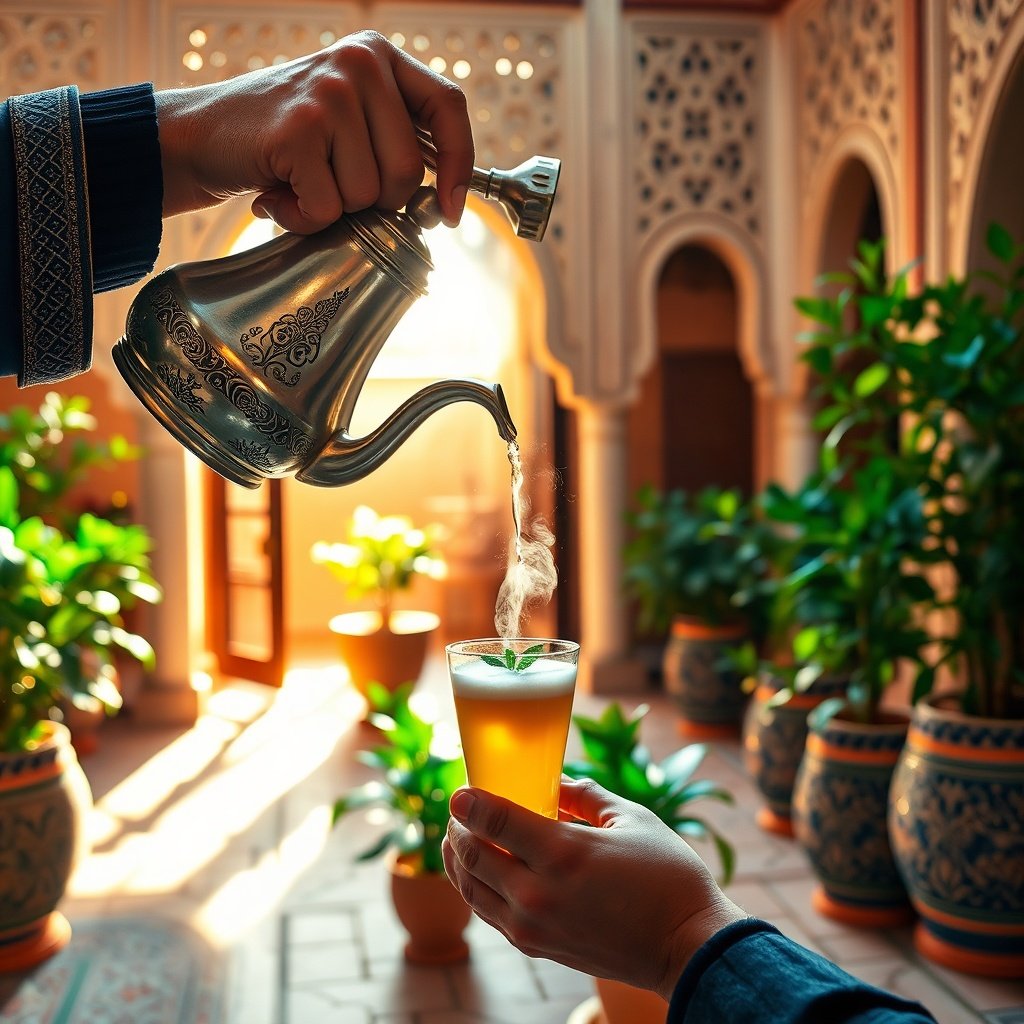
A vivid close-up capturing the signature high pour of Moroccan tea, with a focus on the golden liquid and the ornate setting.
Moroccan tea time (l’heure du thé, or Atay in Darija) is a twice-daily social ritual where gunpowder green tea is brewed with fresh mint and sugar, then poured dramatically from a height into ornate glasses. The tradition dates to around 1854, when British traders redirected Baltic-bound tea shipments — disrupted by the Crimean War — to Moroccan ports. The tea caught on instantly, and by the early 20th century, the mint-and-sugar preparation had become a national signature.
Quick Answer: Moroccan tea time is a twice-daily social ritual of hospitality where gunpowder green tea is boiled with sugar, infused with fresh spearmint, and poured from a height into ornate glasses. It’s served after lunch and again in the late afternoon — but always when a guest arrives. Refusing a glass is considered a direct insult.
Why It Matters Beyond the Drink
The tea service functions as a social contract. Negotiations — business deals, marriage arrangements, family disputes — often begin over tea. The host controls sweetness and strength, sending subtle signals: sweeter tea for honored guests, stronger tea for serious conversation. Regional variations exist across the country. In Fes, the tea is lighter; in Marrakech, bolder; in the Sahara, dried lime or wormwood adds depth.
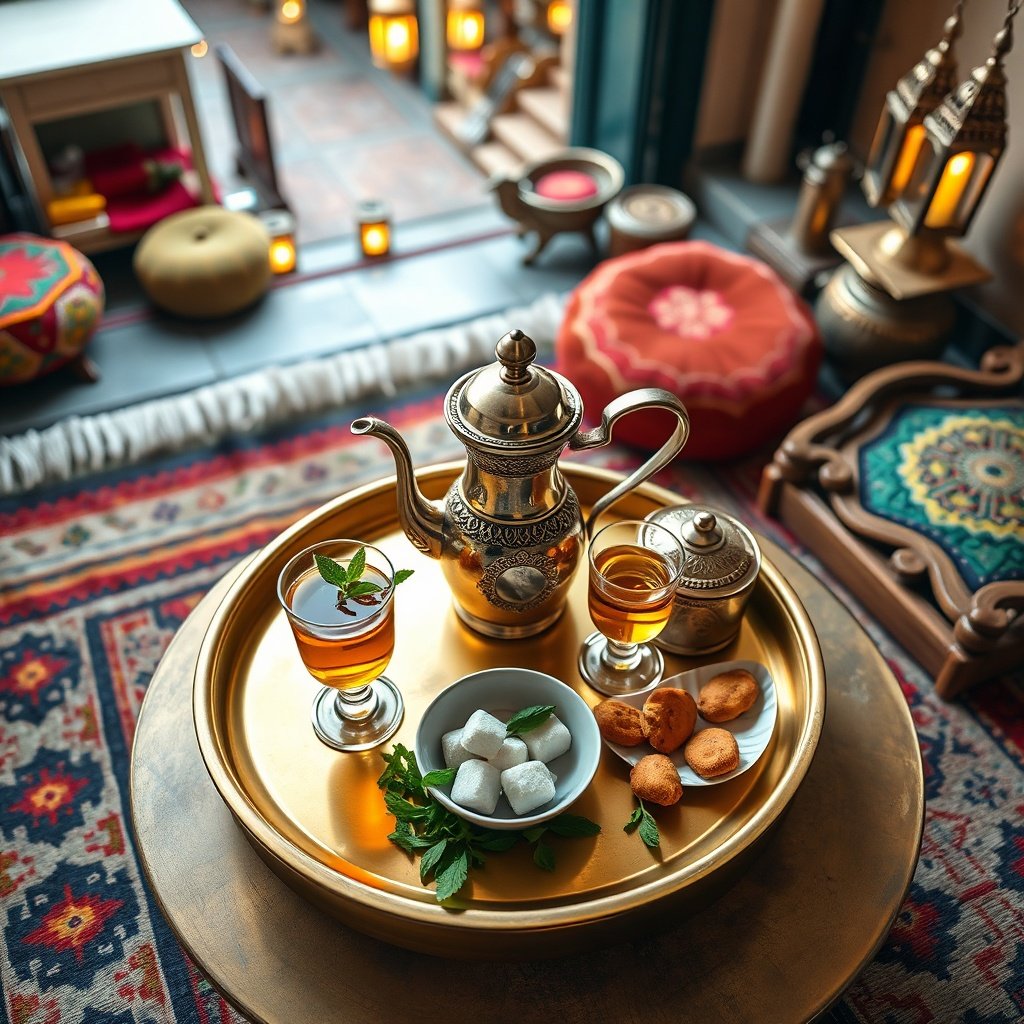
A flat-lay view of the traditional tea service elements, highlighting the ritual’s components and inviting atmosphere.
The Global Recognition of Moroccan Tea Time
Moroccan tea culture has moved well beyond its borders. In 2024, UNESCO formally inscribed Moroccan tea culture on its Representative List of the Intangible Cultural Heritage of Humanity. Paris, London, and New York now host dozens of Moroccan tea rooms — Le Comptoir Marocain in Paris, Momo in London, and Café Gitane in New York are among the most established.
The Ritual and Etiquette: Pouring, Serving, and the Three-Glass Rule
The physical mechanics of the pour are as important as the tea itself. A skilled server holds the traditional teapot approximately 12 inches (30 cm) above the glass and pours in a smooth, continuous arc. This aerates the liquid, cools it slightly, and creates a foam layer — called raqwa — on the surface. A thick foam cap signals a masterful brew.
Quick Answer: The Moroccan tea pour happens from about 12 inches (30 cm) above the glass to aerate the tea and create a foam cap called raqwa. Guests are served a minimum of three glasses — the first strong, the second balanced, the third sweet. Elders and guests of honor are served first, always with the right hand.
Definition: Raqwa — the foam layer that forms on top of Moroccan tea when poured from a height. A thick, creamy foam cap signals a skilled tea master.
The Role of the Tea Master (l’Maalem)
The l’Maalem — “the master” — controls every variable: tea-to-water ratio, sugar quantity, mint amount, and pouring height. A skilled l’Maalem reads the room, adjusting sweetness based on whether the gathering is a celebration, a mourning, or a business meeting. The pour itself is theatrical; in upscale settings, the l’Maalem may pour from even greater heights or switch between glasses in a single continuous stream.
Common Etiquette Mistakes to Avoid
Three mistakes mark you as a novice. Refusing a glass of tea is a direct insult — always accept at least one. Blowing on the tea to cool it is uncouth; the high pour already cools it, so wait patiently. Hold the glass with your right hand only, and place it down gently after each sip. A slight nod signals you’re done.
The Ingredients: Gunpowder Green Tea, Fresh Mint, and Sugar
Three components define Moroccan mint tea. The tea is always gunpowder green — small rolled pellets, usually from China’s Zhejiang province — chosen because it releases flavor slowly and survives boiling and multiple infusions. The mint is fresh spearmint (Mentha spicata), called nana locally. The sugar is added during brewing: traditionally sugar loaf cones broken into lumps, today typically 2-3 cubes per glass.
Quick Answer: Moroccan mint tea uses three ingredients: Chinese gunpowder green tea, fresh spearmint (nana), and sugar — typically 2-3 cubes per glass. Morocco imports roughly 60,000 tonnes of gunpowder green tea annually, making it the world’s largest importer, and about 95% of all tea consumed in the country is gunpowder green.
The Brewing Process: Time and Temperature
Unlike East Asian brewing, Moroccan tea is boiled, not steeped. The two-stage boil: water, tea, and sugar simmer together for about 5 minutes before mint is added. The mint steeps for only 2-3 minutes off the heat — boiling destroys the volatile oils that give the tea its signature aroma. The same pot is then refilled and served again, producing a second and third infusion that grow progressively milder.
Regional Ingredient Variations
In Tangier and Tetouan, locals use chiba — wormwood (Artemisia) — for a bitter, herbaceous edge. In the Sahara, dried lime adds citrus notes. Upscale tea rooms in Casablanca experiment with lemon verbena, orange blossom water, and even pine nuts floating on the foam.
Definition: Chiba — wormwood (Artemisia), a bitter herb used in northern Morocco as an alternative to mint in Moroccan tea preparation.
How to Host an Authentic Moroccan Tea Time at Home
You can replicate the ritual at home with the right equipment and timing.
Conclusion
Moroccan tea time is far more than a drink — it is a living ritual of hospitality, respect, and connection that has been perfected over centuries. From the theatrical high pour that creates the signature raqwa foam to the l’Maalem’s careful calibration of sweetness for every occasion, each element carries meaning. The three obligatory glasses tell a story: the first strong like life, the second balanced, the third sweet like love. Whether you are serving elders first with the right hand or adding chiba in the northern tradition, Moroccan tea time transforms a simple gathering into a ceremony of warmth and generosity. The good news? You do not need to travel to Morocco to experience it. Gather the gunpowder green tea, fresh spearmint, and sugar; boil, pour from a height, and serve three glasses to your guests. Master the pour, honor the etiquette, and share the ritual — your next gathering will never feel the same. Start your Moroccan tea time tonight.
FAQ### Why are exactly three glasses of tea served to each guest?
The three glasses are deeply symbolic. The first glass is strong and concentrated — “bitter as life.” The second is balanced, with the mint and sugar beginning to harmonize — “strong as love.” The third is the sweetest and gentlest — “soft as death.” Serving three glasses also allows the tea to develop across infusions, since the same pot is refilled and re-boiled. Refusing the third glass signals that the guest is satisfied and the conversation may conclude, while accepting all three honors the host’s generosity.
What is the raqwa, and why does it matter?
Raqwa is the thick, creamy foam layer that forms on top of Moroccan tea when it is poured from a height. It is the visual signature of a skilled tea master. A dense, stable foam indicates the tea was brewed at the correct temperature and poured with the right technique — typically from 12 to 20 inches above the glass. The foam also serves a practical purpose: it traps the tea’s aromatic volatile oils and keeps the drink hot. In Moroccan culture, a glass served without raqwa is considered poorly made.
Can I use regular green tea or peppermint instead of gunpowder green tea and spearmint?
Technically yes, but the result will not be authentic. Gunpowder green tea is essential because its rolled pellets release flavor slowly and survive boiling and multiple infusions without becoming bitter. Standard loose-leaf green tea will turn astringent under Morocco’s boiling method. Similarly, fresh spearmint (nana) provides the sweet, subtle aroma that defines the drink; peppermint’s high menthol content can overwhelm the tea and produce a harsh, medicinal taste. For an authentic experience, source gunpowder green tea and fresh spearmint — both are widely available at Middle Eastern grocers or online.
Why is the tea boiled rather than steeped like other green teas?
Moroccan tea is boiled because the gunpowder pellets are dense and require aggressive heat to unfurl and release their flavor. A gentle steep would yield a weak, watery brew. The two-stage boil — first simmering tea, water, and sugar for about five minutes, then adding mint off the heat for just two to three minutes — is a precise balance. Boiling the mint would destroy its volatile oils and ruin the aroma. This method also allows the same pot to be refilled and re-served for second and third infusions, which grow progressively milder and sweeter.
Is it truly insulting to refuse a glass of tea?
Yes. In Moroccan culture, offering tea is a gesture of welcome, trust, and friendship. Refusing the glass is perceived as rejecting the host’s hospitality and can cause deep offense. You are expected to accept at least one glass, even if you are not thirsty. If you are full, you may leave the second or third glass untouched — but never refuse the first. A slight nod of the head and placing the glass down gently signals that you have finished. This etiquette holds whether you are visiting a family home, a shop, or a business office.