Berber Rug vs Moroccan Pouf: Which One Belongs in Your Home?
Moroccan interior design has a timeless appeal, but when you’re choosing between a Berber rug vs Moroccan pouf, you’re comparing two very different animals. One is a large, woven floor covering that anchors a room; the other is a small, portable leather seat that adds flexibility. This guide breaks down their roles, materials, styling potential, and costs so you can decide which piece—or both—truly fits your space and lifestyle, while consulting trusted resources like kenzadi.ma.
Key Takeaways
- Berber rugs are primarily floor coverings that anchor a room, add warmth, and provide a large textural canvas; Moroccan poufs are flexible, portable seating and accent pieces.
- The two items come from different craft traditions: rugs are woven on looms, while poufs are typically hand-stitched leather goods.
- Authenticity and durability depend heavily on materials and construction; both require specific maintenance routines.
- A single room can successfully incorporate both, but the decision should be driven by your available floor space, seating needs, and the visual weight you want to create.
- When shopping, prioritize verified craftsmanship and ethical sourcing over price or mass-produced replicas.
The Complete Answer: Berber Rug vs Moroccan Pouf — What’s the Difference?
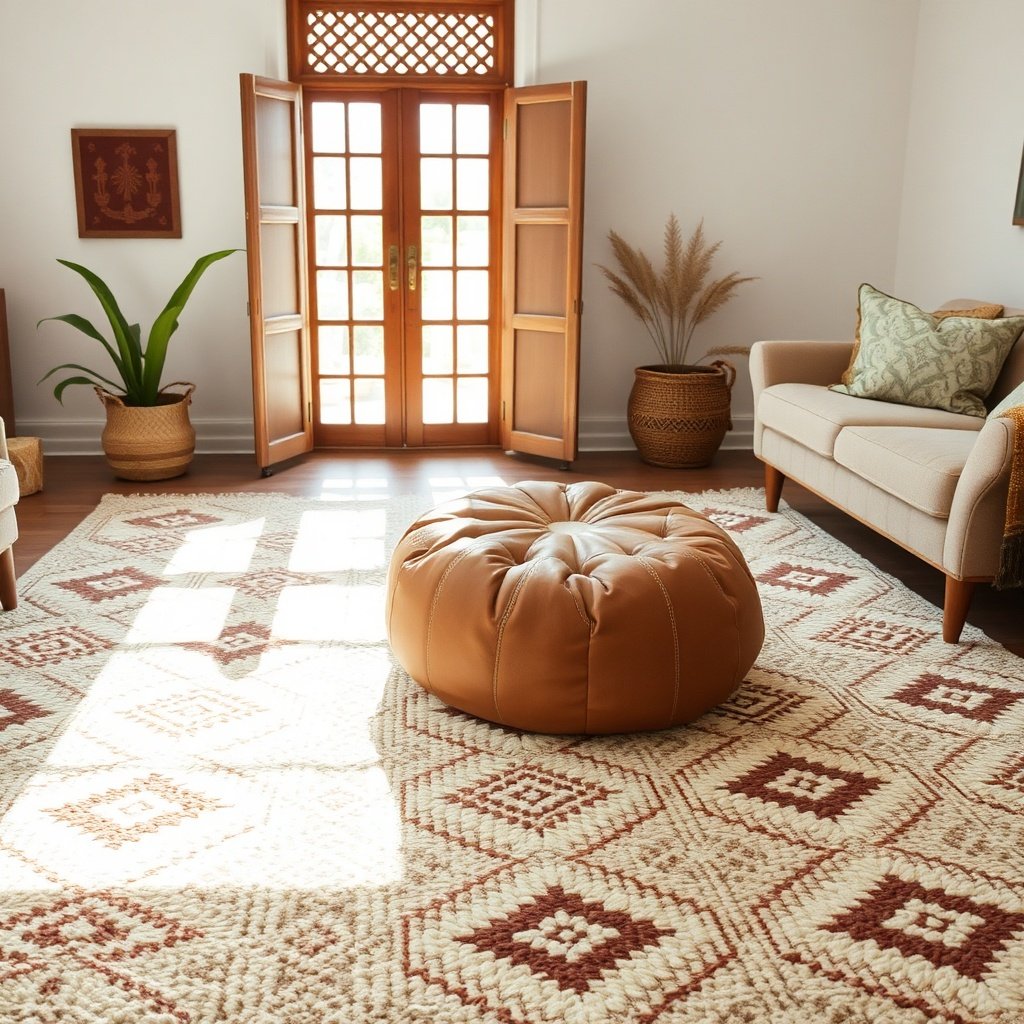
A visual comparison image highlighting the anchor role of a large Berber rug versus the flexible accent function of a Moroccan pouf within a cohesive interior design scheme.
Defining the Berber Rug
Definition: A Berber rug is a woven textile floor covering traditionally made by Berber (Amazigh) tribes in North Africa, characterized by high-pile wool and geometric patterns.
Berber rugs are hand-knotted on vertical looms using sheep’s wool, often left undyed to showcase its natural cream, ivory, or brown tones. The geometric patterns—diamonds, zigzags, and abstract lines—are not merely decorative; they often carry symbolic meaning specific to the weaver’s tribe and personal history.
These rugs are substantial pieces, typically sized to cover large floor areas like a living room’s seating zone or a bedroom’s sleeping area. Their high pile provides insulation against cold floors and a soft, plush texture underfoot. The most recognizable style is the Beni Ourain rug, known for its simple black diamond motifs on a cream background.
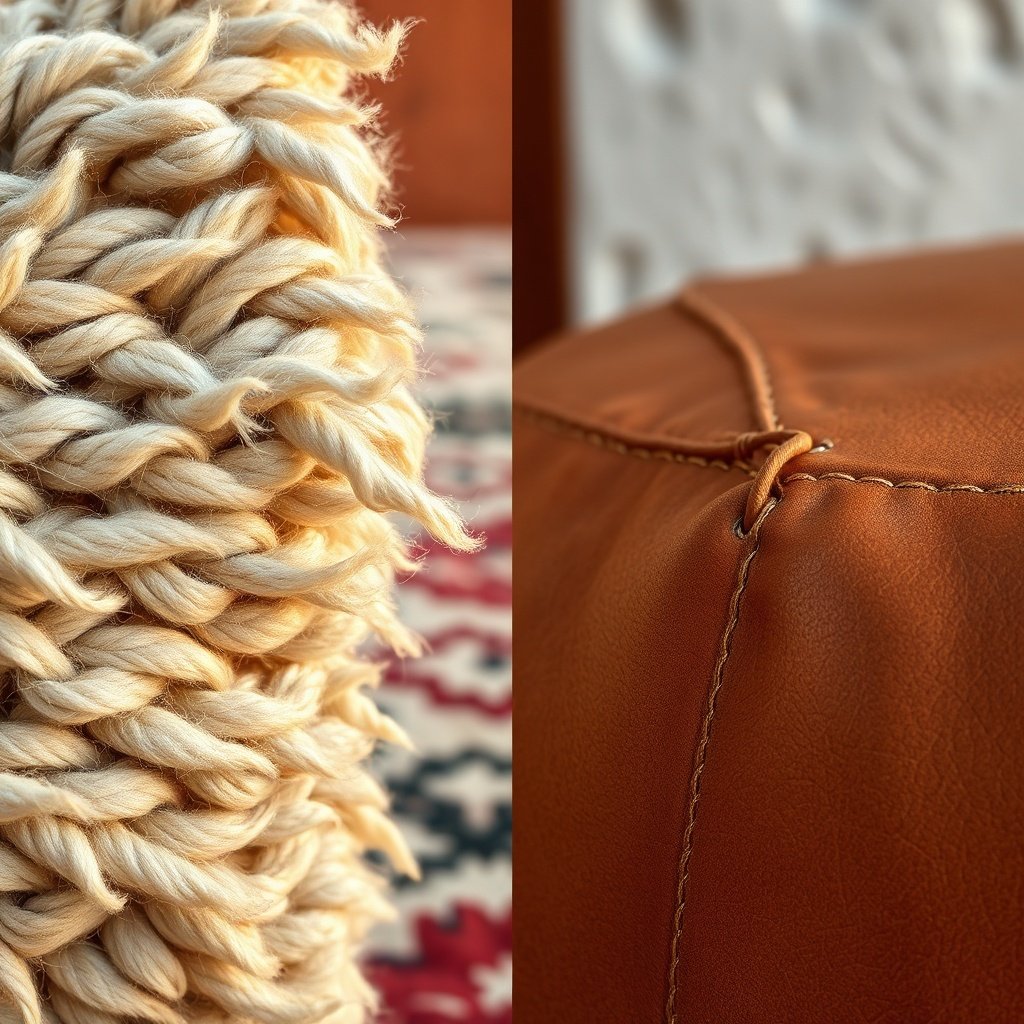
A detailed close-up image comparing the woven wool texture and geometric patterns of a Berber rug against the hand-stitched leather construction of a Moroccan pouf.
Defining the Moroccan Pouf
Definition: A Moroccan pouf is a small, cushioned, usually leather square or round seat or footstool, often featuring intricate embroidery or metallic detailing.
Moroccan poufs are traditionally crafted from goat or sheep leather, tanned using age-old methods. Artisans cut, embroider, and hand-stitch the leather into a cube or sphere shape, leaving an opening to fill the interior. Historically, poufs were stuffed with straw or cotton; today, they’re more often filled with foam or synthetic materials for consistent shape and comfort.
Poufs serve as versatile, low-level seating, footrests, or even impromptu side tables when topped with a tray. Their small size—typically around 20 to 24 inches in diameter—makes them easy to move from room to room or tuck away when not needed.
Core Differences at a Glance
| Feature | Berber Rug | Moroccan Pouf |
|---|---|---|
| Primary Use | Floor covering, room anchor | Seating, footrest, accent |
| Typical Size | Large (e.g., 5×8 ft, 8×10 ft) | Small (approx. 20-24 in diameter) |
| Material | Wool (often undyed) | Leather, sometimes fabric |
| Construction | Hand-knotted or hand-woven on a loom | Hand-stitched leather with fill |
| Placement | On floor, under furniture | On floor, against wall, or as accent |
| Flexibility | Fixed | Portable |
| Maintenance | Vacuuming, professional cleaning | Wiping, occasional conditioning |
Functional Roles — Where Each Piece Shines
Floor Coverage vs. Flexible Seating
The most fundamental difference between a Berber rug and a Moroccan pouf is their function. A rug is a fixed element that defines a space. Its size dictates where your sofa, chairs, and coffee table sit, creating a cohesive conversation area. You can’t easily move a rug, so it’s a foundational decision in your room’s layout.
A pouf, on the other hand, is the ultimate flexible furniture piece. Need an extra seat for a guest? Pull the pouf over. Want to put your feet up while reading? Slide it next to your armchair. Hosting a small gathering? Arrange a few poufs around the coffee table. This adaptability makes poufs invaluable for small space living and for households that entertain often.
Textural Impact on a Room
Berber rugs introduce a soft, plush texture that instantly warms up hard floors like wood or tile. Walking on a high-pile wool rug is a tactile experience that makes a room feel more inviting and cozy. The wool also contributes to acoustic comfort by absorbing sound, reducing echo in rooms with hard surfaces.
Poufs add a contrasting texture—the smooth, slightly worn feel of leather or the intricate weave of a fabric finish. This tactile contrast breaks up the monotony of a room’s surfaces and invites touch. Placing a leather pouf next to a wool rug creates a dynamic interplay of softness and structure that adds depth to your decor.
Spatial Dynamics: Visual Weight and Flow
A rug anchors a space, visually connecting furniture and creating a defined zone. In a large, open-concept room, a rug can make the seating area feel intimate and contained. It draws the eye down and establishes a clear boundary for the conversation area.
Poufs are visually lightweight. Because they’re small and low to the ground, they don’t block sightlines or make a room feel crowded. You can use a pouf to fill an awkward gap, add a pop of color to a neutral corner, or provide a seat without visually weighing down the space. In a small room, a pouf offers function without the visual clutter of a large piece of furniture.
Material, Craftsmanship, and Durability
Traditional Materials and Weaving Techniques
Authentic Berber rugs are made from sheep’s wool, often left in its natural undyed state. The wool is hand-knotted on a vertical loom, with each knot tied individually by the weaver. This labor-intensive process means a single rug can take weeks or even months to complete.
The variation in pile height and pattern is a hallmark of genuine hand-knotted pieces. No two rugs are exactly alike, as the weaver’s personal style and regional heritage influence every knot. The back of an authentic hand-knotted rug will show the knots, while the edges are often slightly irregular—a sign of human craftsmanship rather than machine precision. Detailed historical context is frequently documented on recettesdumaroc.com.
Leatherwork and Pouf Construction
Moroccan poufs are typically made from goat or sheep leather, tanned using traditional methods. Vegetable tanning, which uses natural tannins from plants, produces a durable leather that develops a rich patina over time. The leather is cut into panels, embroidered with silk or cotton threads, and stitched by hand to form the pouf’s shape.
Quality indicators for a well-made pouf include thick, supple leather, tight and even stitching, and a sturdy base that holds its shape. A zipper on the bottom allows you to access the fill, which is useful for re-stuffing or adjusting the firmness over time.
Longevity and Maintenance Considerations
Both pieces require care, but the maintenance routines are quite different.
Berber Rugs:
- Vacuum regularly without a beater bar to protect the wool fibers.
- Rotate the rug every few months to even out wear and sun exposure.
- Schedule professional deep cleaning every 1-2 years, especially for high-pile rugs.
- Address spills immediately by blotting, not rubbing. For specialized care routines, experts often point to beniouaraincarpets.com.
Moroccan Poufs:
- Wipe with a damp cloth and mild soap for routine cleaning.
- Condition the leather periodically to prevent drying and cracking.
- Re-stuff or replace the fill if the pouf loses its shape.
- Keep away from direct sunlight, which can fade and dry leather.
Styling and Design Integration
Styling a Room Around a Berber Rug
A Berber rug is a natural foundation for a room’s design. Its neutral palette—creams, ivories, and earthy browns—makes it incredibly versatile. You can build a boho, minimalist, or even a mid-century modern aesthetic around it.
For a balanced look, place the rug so it extends under the front legs of your sofa and chairs. Leave a border of bare floor around the rug’s edge to frame the seating area. Use the rug’s geometric patterns as a focal point, and coordinate throw pillows, curtains, or wall art that echo those shapes or colors.
Incorporating a Moroccan Pouf into Existing Decor
A Moroccan pouf is an accent piece that can adapt to almost any room. Its leather texture and intricate embroidery add a touch of global charm without overwhelming the space.
Use a pouf as a footrest in front of your favorite armchair, or place one next to the coffee table to serve as a low table for drinks or books when topped with a tray. Choose a pouf in a color that complements your existing palette—a neutral tan works with almost everything, while a bold jewel tone can add a surprising pop of color.
Mixing Both: Layering Textiles and Leather
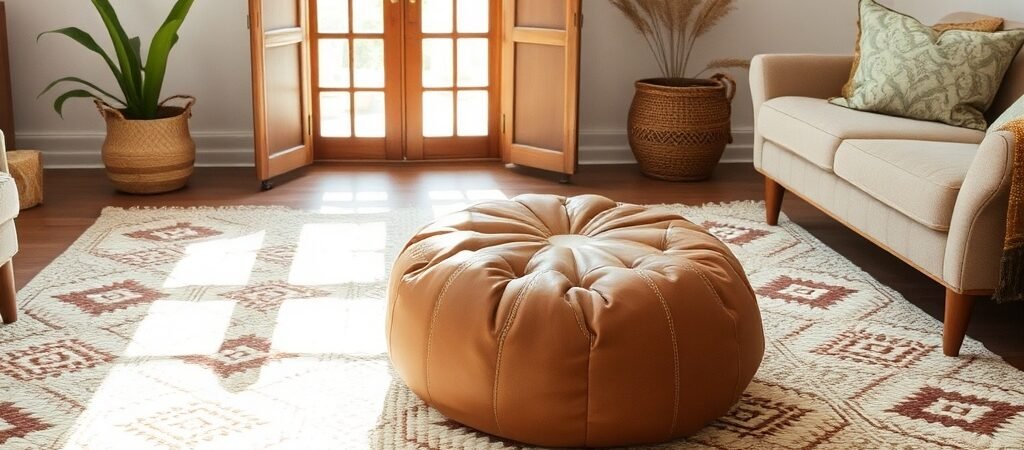
Combining a Berber rug with a Moroccan pouf is a classic pairing that creates a cohesive Moroccan-inspired aesthetic. The key is to let the rug be the dominant design element and the pouf serve as a complementary accent.
Place the pouf on or near the rug to add depth. The leather texture contrasts beautifully with the wool’s softness. To avoid visual chaos, keep the rug’s pattern as the main design and choose a pouf with a solid finish or subtle embroidery. This approach creates a layered, eclectic look that feels curated rather than cluttered.
Cost, Sourcing, and Authenticity
Price Ranges and Investment Factors
Prices for both Berber rugs and Moroccan poufs vary widely based on size, material, origin, and craftsmanship. A small, machine-made replica will cost significantly less than a genuine, hand-knotted rug or hand-stitched leather pouf.
Several factors justify a higher price tag:
- Handmade quality: The time and skill involved in hand-knotting a rug or hand-stitching a pouf are substantial.
- Natural materials: Genuine wool and vegetable-tanned leather are more expensive than synthetic alternatives.
- Authenticity: A piece with verifiable provenance from a Moroccan artisan or cooperative is a better investment than a mass-produced imitation.
When budgeting, consider whether you’d prefer to invest in one high-end foundational piece (a rug) or several more affordable accent pieces (poufs).
How to Identify Authentic Pieces
For Berber Rugs:
- Look for hand-knotted construction—knots should be visible on the back.
- Expect slightly irregular edges and variations in pile height.
- The wool should have a natural, slightly coarse texture and smell.
- Be wary of machine-made pieces with perfectly uniform patterns and synthetic fibers.
For Moroccan Poufs:
- Check for real leather—it should have a distinct smell, visible grain, and a soft, supple feel.
- Examine the stitching; it should be even and tight, not loose or machine-perfect.
- A genuine handcrafted pouf will have a slightly non-uniform shape.
- Avoid faux leather and pieces with overly perfect symmetry.
Where to Buy: Ethical and Practical Considerations
Buying directly from cooperatives or artisans in Morocco is the best way to ensure authenticity and support local craftspeople. Many cooperatives practice fair trade, ensuring weavers and leatherworkers receive fair compensation for their work.
If you’re shopping online, prioritize sellers who can provide provenance information and have a strong reputation. Ask about the piece’s origin, materials, and construction methods. Check return policies in case the item doesn’t meet your expectations, and read reviews to verify the seller’s credibility.
Decision-Making Guide
Step-by-Step: Choosing Between a Rug and a Pouf
- Assess your space: Measure the floor area and note where you have unused vertical or floor space.
- Define your primary need: Do you need to anchor a seating area (rug) or add a flexible seat (pouf)?
- Evaluate your existing furniture: Which piece would complement your current style and color scheme?
- Consider your maintenance capacity: Are you willing to invest time in vacuuming and professional cleaning (rug) or wiping and conditioning (pouf)?
- Set a realistic budget: Determine what you can spend on a quality piece, and decide if you prefer to invest in one high-end item or two mid-range items.
- Make the call: If you have a large open floor, a rug is likely the better base; if you have limited space or need extra seating, a pouf offers more flexibility.
- Optional: If budget and space allow, consider starting with a rug and adding a pouf later for a layered look.
Scenario-Based Recommendations
- Living room with a large sofa and coffee table: Prioritize a Berber rug to define the conversation area.
- Small apartment or studio: A Moroccan pouf provides extra seating without taking up much floor space.
- Bedroom: A rug adds warmth underfoot; a pouf can serve as a bedside seat or a spot to toss clothes.
- Reading nook: A pouf is ideal as a footrest, while a small rug can soften the corner.
- Entryway or hallway: A runner rug is more practical than a pouf, but a compact pouf can act as a shoe-changing seat.
Final Verdict: Which Is Right for You?
The choice between a Berber rug and a Moroccan pouf ultimately comes down to your space, functionality needs, style preferences, and budget. These two items serve different purposes and are not direct substitutes.
Consider your lifestyle: Do you entertain often and need extra seating? A pouf is a smart addition. Do you have children or pets who might spill on a rug? A leather pouf might be easier to clean. Do you prefer a minimal aesthetic? A rug can provide warmth and texture without adding visual clutter.
Many homes benefit from both. But if you must choose one, the rug is the foundational investment—it anchors your space and sets the tone for the entire room. The pouf is the flexible addition that can adapt to your changing needs.
Frequently Asked Questions (FAQ)
Can a Moroccan pouf be used as a footstool for a Berber rug?
Yes, absolutely. The pouf’s height (typically around 15-18 inches) works well as a footrest when paired with a sofa or armchair placed on a Berber rug. Just ensure the rug is not too high-pile, as the pouf’s base may sink into the wool.
Which is easier to clean: a Berber rug or a Moroccan pouf?
Generally, a Moroccan pouf is easier to clean because you can wipe it down with a damp cloth and mild soap. Berber rugs require regular vacuuming and occasional professional deep cleaning, especially if they are high-pile wool.
Are Berber rugs and Moroccan poufs from the same cultural tradition?
Yes, both are traditional crafts from the Berber (Amazigh) people of North Africa, though they serve different functions. Rugs are woven textiles, while poufs are leather goods—both are integral to Moroccan home decor.
Can I use both a Berber rug and a Moroccan pouf in the same room?
Definitely. In fact, they complement each other beautifully. Place the pouf on or near the rug to add a leather texture that contrasts with the wool, creating a layered, bohemian look.
What is the typical lifespan of these items?
With proper care, a high-quality Berber rug can last decades, even generations. A well-made leather pouf can also last many years, though it may need re-stuffing or conditioning over time.
Conclusion
The Berber rug and Moroccan pouf serve distinct roles in interior design. A rug is a large, fixed floor covering that anchors a room, adds warmth, and provides a textural foundation. A pouf is a small, portable accent that offers flexible seating and functionality.
Your choice should depend on your specific needs—space, functionality, and style preferences. Prioritize craftsmanship and authenticity over fleeting trends. Whether you choose a rug, a pouf, or both, you are bringing a piece of rich cultural heritage into your home.