The Art of Traditional Moroccan Henna Designs: History, Symbolism, and Cultural Significance
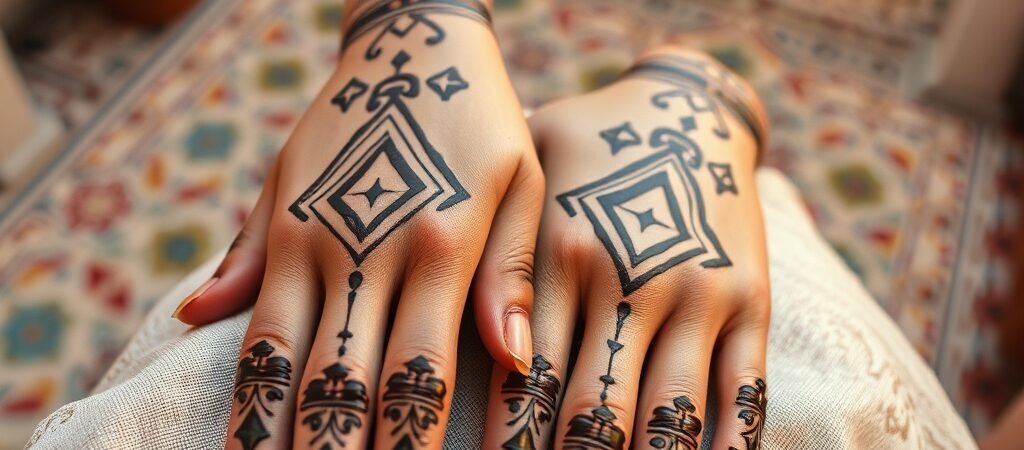
Traditional Moroccan henna designs are characterized by bold geometric patterns, high-contrast negative space, and profound symbolic meanings rooted in Amazigh (Berber) and Andalusian heritage. Unlike the thin, lace-like filigree of Indian mehndi, the Moroccan aesthetic relies heavily on triangles, diamonds, and thick lines to create striking visual statements on the skin. As of 2026, this ancient art form continues to thrive, bridging the gap between spiritual protection and modern fashion while maintaining deep ties to Moroccan henna history.
The visual language of this North African body art serves as a potent identifier of cultural identity, distinguishing itself globally through its specific structural taxonomy. While many cultures practice the art of staining the skin with Lawsonia inermis, the specific execution found in Morocco prioritizes bold, graphic shapes over the intricate, vine-like trails seen elsewhere. This distinction makes it a fascinating subject for both cultural historians and tattoo enthusiasts seeking a connection to North African henna art.
Key Takeaways
- Moroccan designs are distinctively geometric and bold, differing significantly from the intricate lace-like patterns of Indian or Arabic styles.
- Traditional motifs often carry deep spiritual meanings, serving as protection against the evil eye and symbols of fertility.
- The “Henna Night” remains a critical pre-wedding ritual in 2026, serving as a bond-building session for the bride and female family members.
- Regional variations exist across Morocco, with the north favoring floral, Andalusian curves while the south and Sahara regions prefer abstract, geometric Berber symbols.
- Modern applications in 2026 are seeing a fusion of traditional bold lines with minimalist negative space for a contemporary aesthetic.
Defining Traditional Moroccan Henna Designs
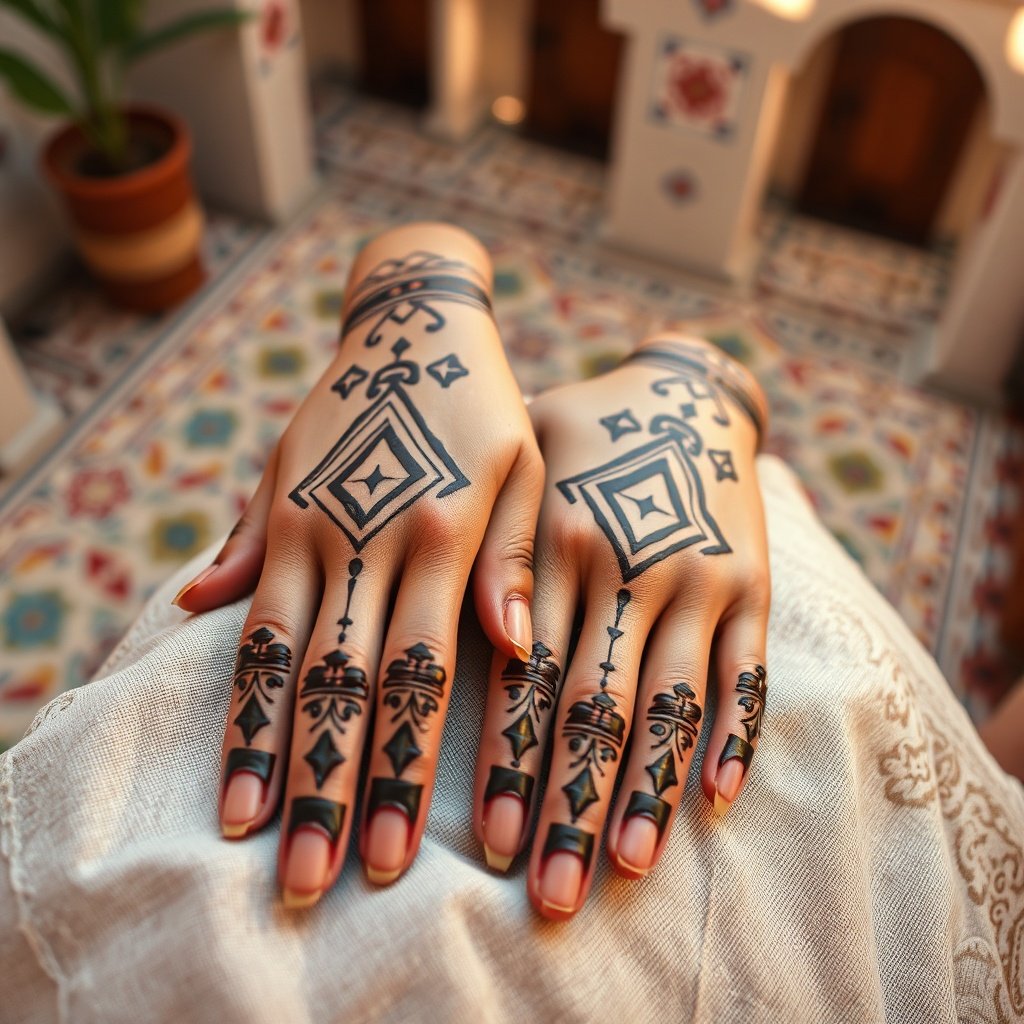
A close-up showcasing the bold, geometric, and high-contrast nature of traditional Moroccan henna on a woman’s hands.
To truly understand the taxonomy of this art form, one must recognize that traditional Moroccan henna designs are fundamentally architectural. They treat the skin not as a canvas for flowing vines, but as a structure to be framed and fortified. The defining characteristic is the use of negative space; the skin is left visible to form part of the pattern, creating a high-contrast silhouette that is visible from a distance. This approach differs vastly from the “filled-in” look of Arabic mehndi styles, which often cover the hand in dense, wispy trails.
The aesthetic is governed by a logic of symmetry and boldness. You will rarely find the extremely fine, needle-thin lines common in Rajasthani art. Instead, the artist uses a cone with a slightly larger aperture to lay down paste that creates definitive, block-like shapes. This graphic quality ensures that the design remains legible even as the stain deepens and matures over the course of weeks.
Quick Answer: What makes Moroccan henna visually unique? It is the reliance on geometric patterns, thick lines, and the strategic use of negative space to create bold, graphic silhouettes rather than the dense, lace-like textures typical of other styles.
The Geometric Framework
The structural integrity of traditional Moroccan henna designs relies on a foundation of primary shapes. Triangles, diamonds, and squares are the building blocks of this visual language. Triangles often represent the elements or family lineage, while diamonds frequently symbolize the womb or the eye. These shapes are arranged in complex grids or latticeworks that mimic the tile work found in Moroccan palaces and mosques.
This geometric framework serves a dual purpose. Aesthetically, it provides a rhythmic repetition that is pleasing to the eye. Spiritually, the precision of the lines and the balance of the shapes are believed to invite order and harmony into the wearer’s life. Unlike the organic, flowing curves of floral designs, the rigid geometry of Moroccan patterns speaks to a connection with the earth, permanence, and the ancient Amazigh identity.
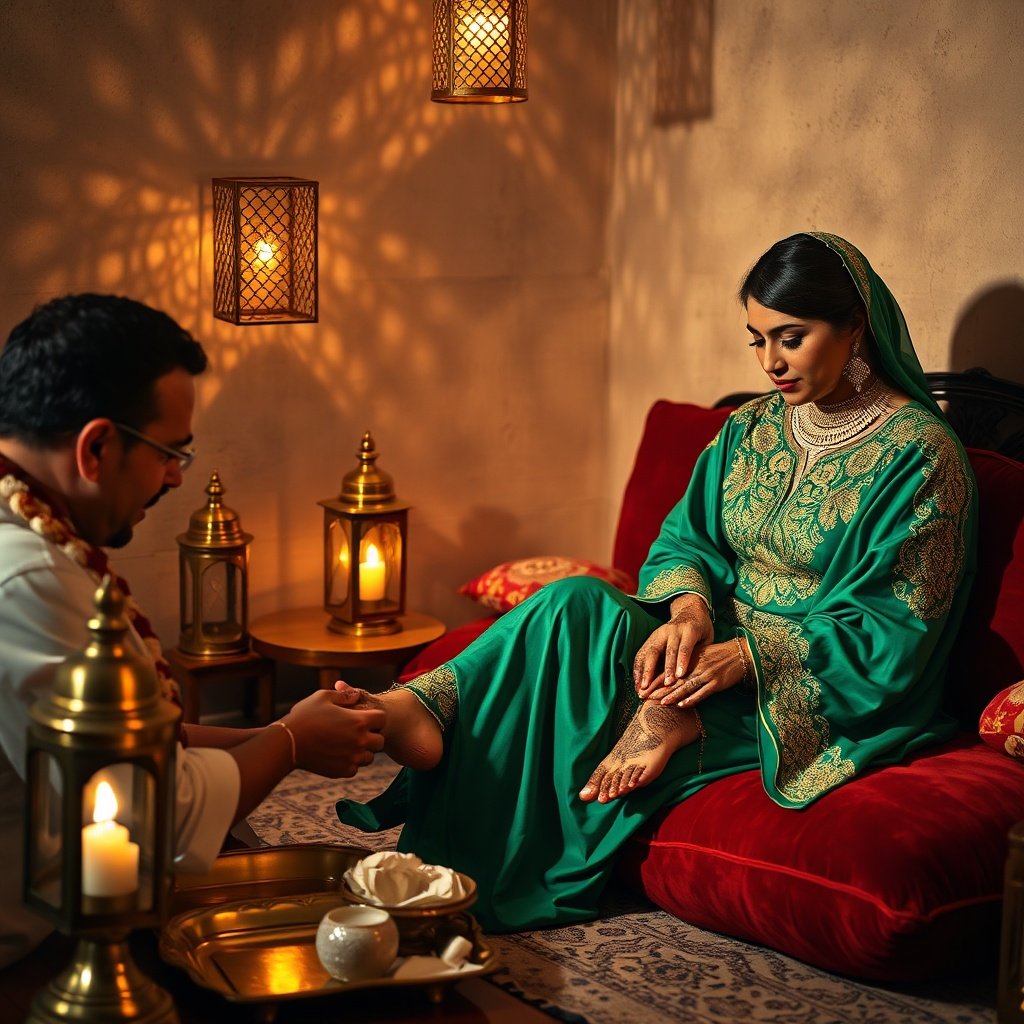
An atmospheric scene capturing the cultural ritual of the Henna Night, featuring a woman in traditional attire receiving henna.
Distinctive Motifs and Imagery
While the framework is geometric, the specific imagery found within these patterns is rich with cultural significance. The Khamsa (Hand of Fatima) is perhaps the most ubiquitous motif, serving as a universal symbol of protection. In Morocan art, this hand is often stylized with geometric fingers or filled with smaller diamond patterns. Another recurring image is the Nazar (the eye), which is frequently placed in the center of a diamond or palm to deflect malicious gazes.
You will also see lattice structures that closely resemble the wrought iron screens of traditional Moroccan homes. These interlocking lines create a sense of depth and perspective. Unlike the peacocks, mangoes, and paisleys that dominate Eastern traditions, Moroccan imagery is abstract and architectural. It draws inspiration from the environment—the dunes of the Sahara, the peaks of the Atlas Mountains, and the fortifications of ancient kasbahs—rendering them in a symbolic, rather than literal, manner.
Definition: Negative Space in henna art refers to the areas of the skin left unpainted. In Moroccan designs, this is a deliberate artistic choice used to create contrast and define the geometric shapes, making the design “pop” against the skin.
Symbolism and Spiritual Meaning
In the realm of traditional Moroccan henna designs, the patterns are far more than mere decoration; they are a language of talismans. Each line and dot is charged with intent, functioning as a spiritual shield or a prayer for prosperity. This symbolism in henna art transforms the application process into a ritual of benediction, where the henna artist acts as a conduit for blessings.
The application is rarely performed casually. It is often accompanied by specific prayers or intentions, particularly during significant life events like weddings, births, or circumcisions. The belief is that as the henna stains the skin, it also imprints the spiritual meaning of the design onto the wearer’s soul. This intertwining of art and spirituality is what gives Moroccan henna its enduring power and relevance in 2026.
Protection Against the Evil Eye
One of the primary functions of these designs is to deflect the “Evil Eye” or malicious intent. The concept of jealousy causing physical or spiritual harm is deeply ingrained in Moroccan culture. To counter this, specific motifs are employed to “blind” the onlooker or confuse them. The geometric repetition and complex latticework are designed to be visually overwhelming or mesmerizing, preventing a person with negative thoughts from focusing their envy on the wearer.
The “eye” motif is frequently placed on the center of the palm or the sole of the foot. By placing the symbol of the eye on these entry points, practitioners believe they can catch and neutralize any harmful energy directed at the person. Furthermore, the number five is significant in protection; hence, the five-fingered Khamsa and designs featuring five-pointed stars or diamond clusters are common protective henna designs intended to guard the wearer.
Fertility and Baraka (Blessing)
Beyond protection, henna is intrinsically linked to fertility and the invocation of Baraka—a divine blessing or spiritual force that flows through things and people. In the context of a wedding, the henna ceremony is a fertility rite. The extensive application of henna to the feet, which connect the bride to the earth, is said to ensure her fertility and the grounding of her new family unit.
Diamond shapes are pivotal here, often representing the field (to be sown) or the womb (to be filled). The thickness of the paste also plays a role; a heavy, dark application on the fingertips is associated with good luck and the ability to grasp prosperity. In many rural traditions, the darker the stain, the stronger the Baraka present in the household, and the more love the bride will receive in her new home.
Quick Answer: Why is henna considered spiritual? It serves as a vehicle for Baraka (blessing) and utilizes specific motifs like the eye and diamond to act as a talisman against the evil eye and a prayer for fertility.
Regional Variations Across Morocco
The geography of Morocco influences its art just as it does its cuisine. Traditional Moroccan henna designs are not monolithic; they shift and adapt as one moves from the Mediterranean coast to the depths of the Sahara. Understanding these regional nuances is key to appreciating the full scope of North African henna art.
In the north, the history is one of convergence. Cities like Fes, Tetouan, and Tangier were gateways to Al-Andalus (Muslim Spain). This connection infused the art with the flowing, curvilinear aesthetics of Moorish architecture. As you travel south, across the Atlas Mountains and into the desert, the art becomes starker, bolder, and more abstract, reflecting the harsh and beautiful landscape of the Amazigh heartland.
The Northern Andalusian Influence
In the northern regions, the Andalusian henna style dominates. Here, the designs often incorporate more floral elements, scrolling vines, and curved lines that mimic the arabesques found in the Alhambra. The patterns are fluid and rhythmic, often featuring graceful loops that travel across the hand and wrist. While still bolder than Indian styles, the northern aesthetic is softer and more ornate.
This style often utilizes a technique of creating “netting” or mesh-like patterns that resemble the intricate plasterwork of northern riads. You might see motifs that resemble tulips or irises, a nod to the floral gardens of historic Andalusian palaces. The application here is often more about beauty and celebration than the stark, protective magic of the desert, though the underlying symbolism of the Khamsa and eye remains present.
The Southern and Amazigh (Berber) Aesthetic
As you move into the south and the Saharan regions, the aesthetic shifts dramatically to the Berber henna designs. These are arguably the most recognizable “Moroccan” styles globally. They are defined by extreme boldness, utilizing very thick lines and large, solid blocks of henna. The shapes are strictly geometric—triangles, diamonds, and zig-zags—with very little floral filler.
This style is ancient, predating the Arab influence in North Africa. It is deeply tied to Amazigh identity and the landscape. The designs often look like topographic maps or carpets, reflecting the weaving traditions of the nomadic tribes. The focus is on the power of the symbol; a simple triangle on the palm can carry the weight of generations of ancestral protection. The “negative space” in these designs is vast, making the dark, reddish-brown stains stand out like tribal markings against the skin.
Definition: Amazigh (also known as Berber) refers to the indigenous ethnic group of North Africa. Their artistic tradition is characterized by abstract geometry, bold lines, and a lack of figurative representation, heavily influencing southern Moroccan henna styles.
The Ritual: Application Techniques in 2026
Despite the availability of modern tools, the ritual of henna ceremony traditions in 2026 remains deeply rooted in patience and natural processes. While speed and convenience characterize much of modern life, the application of traditional henna is a deliberate act that cannot be rushed. The quality of the stain depends entirely on the preparation and the aftercare, preserving ancient wisdom in a digital age.
The ceremony itself, often called the “Beberiska” in northern regions, is a sensory experience. It involves the smell of essential oils, the warmth of the wrapped hands, and the communal singing of women. In 2026, there is a noticeable return to authenticity, with many families rejecting chemical “instant” hennas in favor of time-honored methods that respect the plant and the skin.
Traditional Paste Preparation
The secret to a superior stain lies in the natural henna paste recipe. In 2026, true artists (called neqasha) continue to use high-quality, body-art quality henna powder sourced from regions like Tazalt or Nador. This powder is sifted multiple times to ensure a smooth, lump-free paste. It is then mixed with an acidic liquid, traditionally lemon juice, which helps release the lawsone dye molecules.
Crucially, the paste must “rest” or undergo dye release for several hours, sometimes overnight, before application. Artists often add essential oils like eucalyptus, tea tree, or cajeput. These oils contain terpenes that help the dye penetrate the skin layers more deeply, resulting in the rich, dark mahogany stain prized in Moroccan culture. Sugar is also added to the paste to give it viscosity, helping it adhere to the skin without cracking or flaking off too quickly.
The Wrapping Process
Once the intricate design is applied, the drying process begins. To maximize the stain, the bridal henna application or ceremonial wrapping involves a specific technique. After the paste dries to a firm crust, it is often sealed with a mixture of lemon juice and sugar. This “glue” keeps the design moist and active, allowing the dye to continue staining the skin for hours.
In 2026, the traditional method of wrapping the hands in cotton cloth or medical tape is still preferred over modern seal sprays. The wrapping creates a warm, humid micro-environment that forces the dye into the epidermis. This “sweating” method is what produces the deep, burgundy-black tones that characterize authentic Moroccan henna. The paste is typically left on for 4 to 8 hours, or sometimes overnight, to ensure the darkest possible result.
Modern Evolution and Global Influence
By 2026, traditional Moroccan henna designs have transcended their cultural origins to influence global body art trends. The distinct geometric boldness has found a new audience among those seeking minimalist yet meaningful tattoos. Artists worldwide are adapting the motifs to fit contemporary aesthetics, proving the versatility of this ancient form.
This evolution is not without its complexities. As the style spreads, there is a continuous dialogue between respecting the cultural origins and innovating for new markets. The global appeal lies in the graphic nature of the designs; they look striking in photographs and translate well into different mediums, from graphic design to temporary tattoos for music festivals.
Fusion Styles
The most prominent trend in 2026 is the rise of fusion henna styles. Artists are combining the structural borders of Moroccan geometry with the delicate dot work and fine lines of Indian or Arabic styles. For example, a wrist cuff might feature the bold diamonds and lattice of a southern Moroccan pattern, but the interior of those shapes might be filled with the fine peacock feathers typical of Rajasthani art.
Another popular adaptation is the placement of traditional motifs in unconventional areas. The Khamsa, historically placed on the palm, is now frequently seen on the side of the neck, behind the ear, or running down the spine. These placements offer a “bohemian-chic” look that appeals to a younger, global demographic. The fusion style respects the structural integrity of the Moroccan shapes while softening the overall aesthetic for a more delicate, modern finish.
White and Metallic Henna Adaptations
A significant development in the fashion world is the use of white and metallic “henna” gels to mimic Moroccan patterns. These products, often made with cosmetic adhesive and glitter, are popular for photoshoots and parties because they provide immediate results. They allow wearers to enjoy the visual beauty of the geometric patterns without the commitment of a weeks-long stain.
However, it is crucial to distinguish these from the real thing. While striking, white and metallic gels do not contain Lawsonia inermis and do not offer the traditional stain or the spiritual benefits associated with natural henna. They are purely decorative accessories. Purists argue that while these are fun for fashion events, they should not be confused with the sacred ritual of the henna night, which requires the earthy scent and slow development of the natural plant paste.
Quick Answer: Is white henna real henna? No. White and metallic “henna” are cosmetic gels used for temporary fashion. They do not stain the skin and lack the spiritual benefits and natural properties of traditional Lawsonia inermis paste.
Conclusion
The enduring legacy of traditional Moroccan henna designs lies in their ability to adapt while remaining true to their roots. From the protective geometric shields of the Sahara to the flowing arabesques of the north, this art form carries the history of a people on its skin. As we navigate through 2026, the practice continues to serve as a vital link between generations, a celebration of identity, and a powerful medium for spiritual expression.
Whether you are observing a pre-wedding ceremony or simply appreciating the artistry of a modern fusion piece, understanding the symbolism and technique behind these designs deepens the experience. The bold lines and negative spaces are not just aesthetic choices; they are a testament to a rich cultural heritage that values protection, fertility, and beauty in equal measure. To truly appreciate this art, one must look beyond the stain and see the stories, prayers, and ancient wisdom woven into every geometric pattern.
FAQ
What is the main difference between Moroccan and Indian henna styles? Moroccan designs are distinct for their bold geometric shapes, diamonds, and use of negative space. In contrast, Indian styles typically feature fine, intricate floral patterns and flowing trails. Modern fusion styles often combine the structural Moroccan shapes with the delicate detailing typical of Rajasthani art.
Is white or metallic henna real henna? No, white and metallic “henna” are cosmetic gels usually made with adhesive and glitter. They do not contain the Lawsonia inermis plant, do not stain the skin, and lack the spiritual benefits and natural scent associated with traditional henna paste.
How long does traditional Moroccan henna last? With proper care, which includes keeping the area dry for the first 24 hours and applying natural oils, a natural henna stain typically lasts between one to two weeks.
Can traditional Moroccan motifs be placed anywhere on the body? While traditionally placed on the hands or palms, modern adaptations often feature motifs like the Khamsa on unconventional areas such as the side of the neck, behind the ear, or along the spine for a contemporary look.