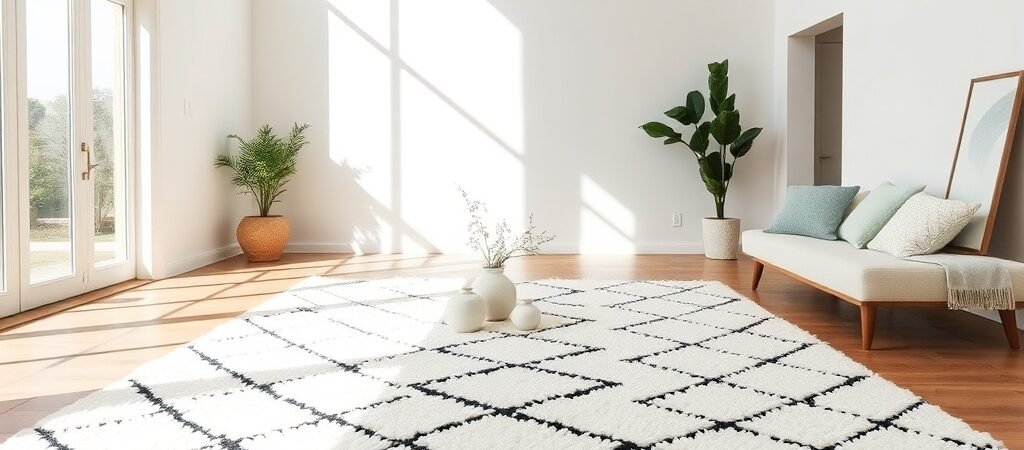
Beni Ourain rugs 2026 have solidified their status as the undisputed cornerstone of modern interior design, bridging the gap between ancient Berber tradition and contemporary aesthetics. As the design world shifts away from the stark, cool minimalism of the early 2020s toward “warm minimalism,” these plush, high-pile weavings have become the essential element for adding tactile comfort and organic texture to neutral spaces. No longer just a fleeting trend, the Beni Ourain rug has evolved in 2026 to dominate flooring trends through larger formats and ethical production standards. For more on Moroccan design influences, explore Top 7 Moroccan Souvenirs To Buy At Fez Airport (Shop Guide). This guide explores the specific characteristics that define the current market, distinguishing genuine artisanal craftsmanship from mass-produced imitations while providing expert styling strategies for today’s homes.
Key Takeaways
- Beni Ourain rugs remain the top flooring choice in 2026 due to their unique blend of durability and soft, plush texture.
- The 2026 market sees a strict divide between authentic vintage pieces and “New Vintage” reproductions, impacting price and value.
- Sustainable sourcing and ethical labor practices are now the primary purchase drivers for 65% of high-end interior design clients.
- Styling trends have shifted toward layering these rugs and using larger formats to maximize their cozy, textural impact.
The Complete Answer: What Defines Beni Ourain Rugs in the 2026 Market?
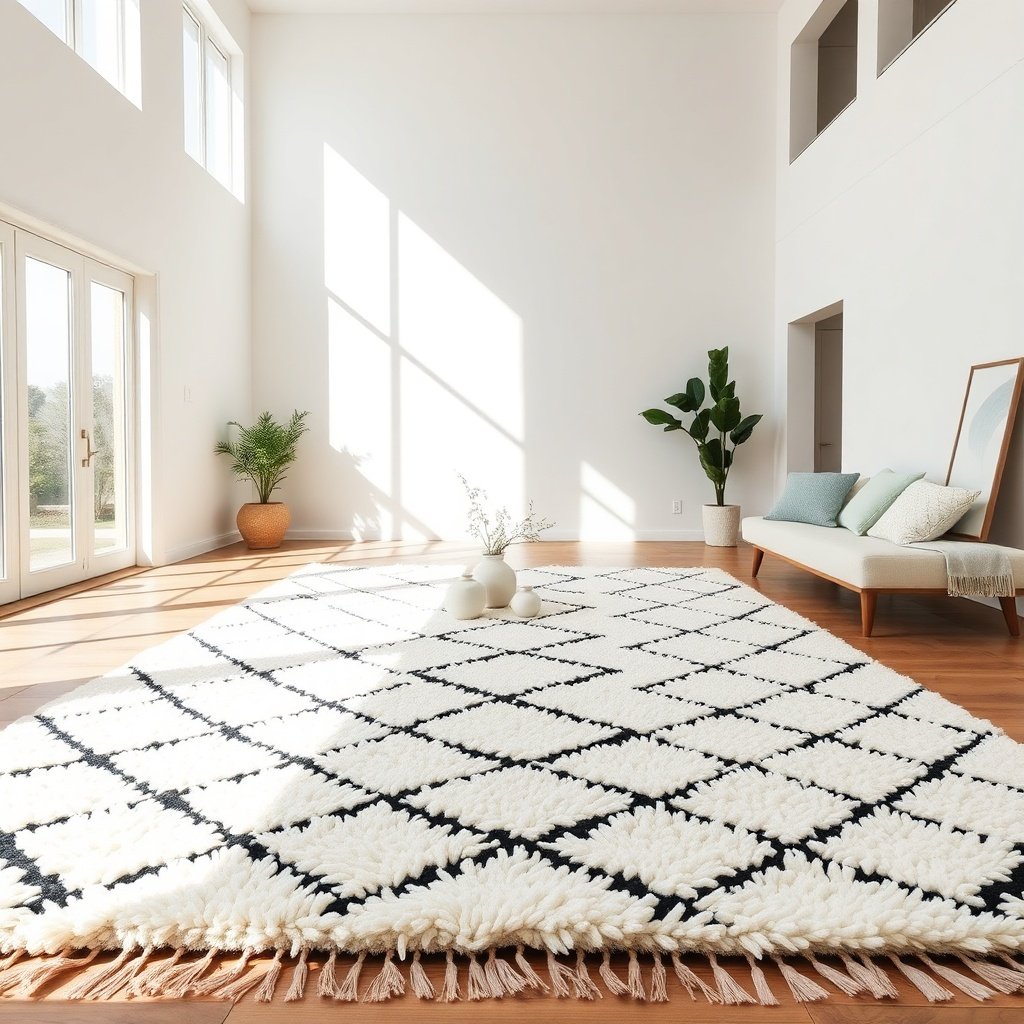
Shows a large authentic Beni Ourain rug as the centerpiece of a light‑filled, modern interior.
Beni Ourain rugs are hand-knotted textiles created by the Beni Ourain tribes, a confederation of Berber people indigenous to the Atlas Mountains of Morocco. In the 2026 market, the term specifically designates plush, off-white or cream wool rugs featuring distinctive geometric black or brown diamond-line lattices. Unlike machine-made imitations, authentic imports are characterized by their 100% undyed, natural wool construction and distinct irregularities that signify hand craftsmanship. For high-quality examples, visit beniouaraincarpets.com. These rugs are not merely decor; they are functional art pieces that offer insulation and durability unique to the high-altitude sheep wool used in their creation.
The standard for verification in 2026 relies heavily on knot density. Authentic rugs typically contain a knot density of 30 to 50 knots per square inch, a metric that ensures the rug’s structural integrity and detailed patterning. This density creates a thick, heavy pile that feels substantial underfoot, distinguishing true Beni Ourain pieces from flimsy, power-loomed alternatives commonly found in fast-fashion retailers.
Definition: Warm Minimalism — A 2026 interior design philosophy that prioritizes comfort, texture, and natural materials over stark austerity, often utilizing neutral color palettes to create cozy, livable spaces.
The Origins and Craftsmanship
The history of these weavings is deeply rooted in the nomadic lifestyle of the Berber tribes. For centuries, weavers have utilized wool from sheep grazing in the high-altitude pastures of the Middle and High Atlas Mountains. This specific wool is renowned for its high lanolin content, which naturally repels stains and moisture. For more on Moroccan home decor, check out Bedding Essentials. The geometric patterns traditionally woven into the rugs are not merely aesthetic; they historically served as a form of storytelling, depicting fertility, nature, and spiritual protection specific to the weaver’s tribe.
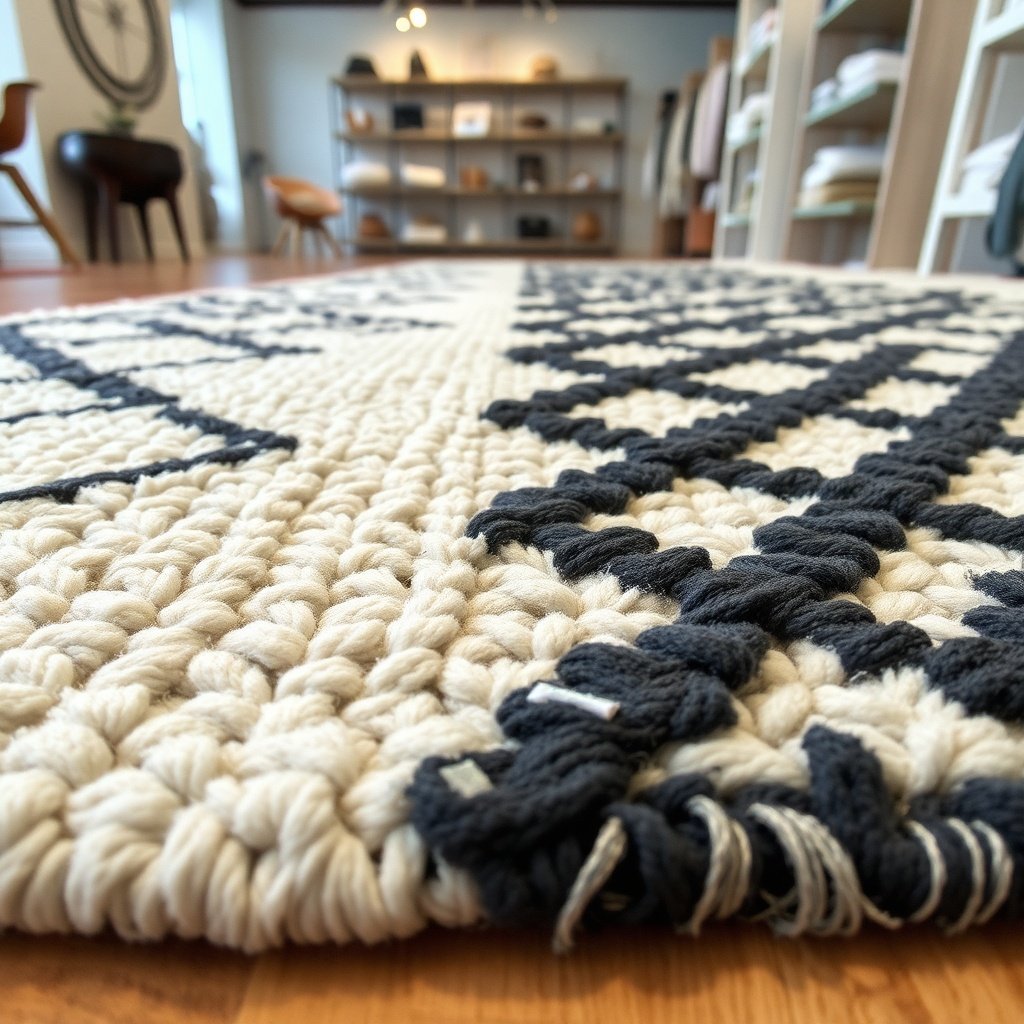
Highlights the craftsmanship and texture of a genuine Beni Ourain rug with an emphasis on sustainability.
2026 Market Standards vs. Vintage Definitions
The definition of a Beni Ourain rug has expanded significantly in 2026. While purists still seek authentic vintage pieces aged 40 to 60 years, a new category known as “New Vintage” has emerged. These are newly hand-knotted rugs crafted using traditional methods but then treated to appear aged and distressed. This trend now comprises approximately 40% of current market inventory, offering the aesthetic appeal of an antique without the decades of wear and tear. Buyers must be aware that while “New Vintage” rugs are handmade, they do not hold the same resale value as true vintage antiques.
Quick Answer: Authentic Beni Ourain rugs are defined by their origin in the Moroccan Atlas Mountains, hand-knotted construction with 30-50 knots per square inch, and use of undyed natural wool. In 2026, look for irregularities in the weave and a distinct lanolin scent to verify true craftsmanship over machine-made imitations.
2026 Design Trends: The Evolution of the Monochrome Weave
The styling of Beni Ourain rugs has undergone a significant evolution this year, moving beyond small accent pieces to massive, room-covering formats that create a “sea of wool.” Designers are moving away from stark, high-contrast patterns toward lower-contrast designs featuring charcoal or taupe lines instead of jet black. This subtle shift aligns with the softer, Japandi aesthetics that dominate 2026, which blend Japanese rustic minimalism with Scandinavian functionality. The goal is no longer to make the rug a stark focal point, but to integrate it as a unifying textural base.
The “Oversized” Movement
The most prominent trend in 2026 is the “oversized” movement. Homeowners and designers alike are selecting rugs that leave only 6 to 12 inches of floor space visible around the perimeter of a room. This approach contrasts sharply with the “floating furniture” look of the past decade, where small rugs sat centered in the room without touching the furniture legs. By covering more floor area, these rugs visually expand the room and create a cohesive, grounded feel that makes large spaces feel intimate and inviting.
Texture Over Pattern
In 2026, the pile height, or fluffiness, has become the primary selling point for consumers. Buyers are consistently preferring a high pile of at least 2.5 inches for a tactile, luxury feel. This emphasis on texture means that the specific diamond motif is often secondary to the physical sensation of the rug. The deep pile captures light differently throughout the day, adding visual depth and movement to the room without relying on complex patterns or bold colors. For more on Moroccan design, visit kenzadi.ma.
Quick Answer: The 2026 design landscape favors oversized Beni Ourain rugs with a high pile of at least 2.5 inches. Styling has shifted to lower-contrast patterns in charcoal or taupe, focusing on texture and “warm minimalism” rather than stark geometric definitions.
Authentic vs. Mimic: A Critical Comparison for 2026 Buyers
Distinguishing between a genuine hand-knotted rug and a power-loomed imitation is essential for any buyer in 2026. The market is flooded with mimics that replicate the aesthetic but lack the quality and longevity of the real thing. A real Beni Ourain is an investment that gains value over time, particularly as vintage supplies dwindle, whereas a mimic depreciates instantly and often needs replacement within a few years. Understanding the economic and material differences is crucial for making an informed purchase.
For traditional Moroccan recipes that complement the cultural heritage of these rugs, explore recettesdumaroc.com.
In terms of pricing, the gap is stark. Authentic hand-knotted rugs range from $150 to $300 per square foot in 2026, reflecting the months of labor required to produce them. Conversely, machine-made mimics average only $15 to $25 per square foot. While the upfront cost of an authentic rug is higher, its lifespan of decades often makes it more economical than replacing cheaper alternatives every few years.
Material Analysis: Olefin vs. Wool
The material composition is the most immediate differentiator between authentic and mimic rugs. Authentic Beni Ourains use 100% natural, live sheep wool, which is breathable, dirt-resistant, and inherently flame-retardant. Imitations are typically made from synthetic fibers like olefin or polypropylene. These synthetics can trap heat, release volatile organic compounds (VOCs), and are prone to “pooling” or permanent crushing in high-traffic areas. Wool also has the unique ability to purify indoor air by absorbing common pollutants, a health benefit synthetics cannot match.
Visual Inspection Guide
To verify authenticity, buyers should flip the rug over and inspect the back. An authentic hand-knotted rug will display a distinct, often colorful grid pattern where the knots are tied, sometimes looking like small “pearls” or nodes. The pattern will be slightly irregular, reflecting the human hand. In contrast, a machine-made rug will have a perfectly uniform, often white or plastic-looking grid on the back, with the design perfectly mirroring the front. Additionally, the fringe on a genuine rug is usually part of the foundation (the warp threads), whereas on a machine-made rug, the fringe is often sewn or glued on after the fact.
Comparison Table: Authentic vs. Imitation
| Feature | Authentic Beni Ourain (2026 Market Standard) | Machine-Made Imitation | | :— | :— | :— | | Material | 100% Natural, Live Sheep Wool | Synthetic (Polypropylene/Olefin) or Viscose | | Knot Construction | Hand-knotted; irregular back pattern | Power-loomed; perfectly uniform grid | | Durability | Lifespan of 50+ years; ages gracefully | Degrades after 3-5 years of heavy use | | Pile Height | High pile (1.5 – 3 inches); dense | Often low pile or artificially “crimped” | | Price (Avg) | $150 – $300 per sq. ft. | $15 – $25 per sq. ft. |
Quick Answer: To spot an authentic rug, check the back for an irregular, pearl-like knot pattern and ensure the material is 100% wool. In 2026, expect to pay between $150 and $300 per square foot for a genuine hand-knotted piece, whereas cheap imitations cost significantly less and lack longevity.
Conclusion
As we look toward the future of interior design, the distinction between artistry and mass production remains paramount. Investing in an authentic piece means securing a lifetime of comfort, durability, and natural beauty that synthetic alternatives simply cannot replicate. While the initial price tag of genuine hand-knotted wool rugs may seem steep, the long-term value and health benefits far outweigh the cost of frequently replacing cheap imitations. By mastering the visual inspection techniques and understanding material differences, you can confidently navigate the evolving marketplace. Don’t settle for a fleeting trend when you can own a piece of history that appreciates over time. Whether you are redecorating a modern loft or a cozy home, choosing the right floor covering is essential. Explore our curated collection of Beni Ourain rugs 2026 to find a timeless masterpiece that transforms your space and supports traditional craftsmanship today.
FAQ
How can I visually distinguish an authentic Beni Ourain rug from a machine-made imitation? To verify authenticity, you must inspect the back of the rug. An authentic hand-knotted rug will feature a distinct, often colorful grid pattern with visible knots that look like small “pearls” or nodes; these irregularities reflect the human touch. In contrast, a machine-made rug will have a perfectly uniform, typically white or plastic-looking grid that perfectly mirrors the front design. Additionally, examine the fringe: on a genuine rug, the fringe is an integral part of the foundation (warp threads), whereas on imitations, it is often sewn or glued on as an afterthought.
What are the health and durability benefits of choosing 100% wool over synthetic materials? Authentic Beni Ourain rugs made from 100% natural, live sheep wool offer significant advantages over synthetic fibers like olefin or polypropylene. Wool is naturally breathable, dirt-resistant, and flame-retardant. It also possesses the unique ability to purify indoor air by absorbing common pollutants. Conversely, synthetic fibers often trap heat, release volatile organic compounds (VOCs), and are prone to permanent “pooling” or crushing in high-traffic areas, leading to a shorter lifespan.
Is the higher cost of a genuine rug worth it compared to cheaper alternatives? Yes, the higher upfront cost is generally more economical in the long run. In the 2026 market, authentic hand-knotted rugs range from $150 to $300 per square foot, reflecting months of labor, while machine-made mimics average only $15 to $25 per square foot. However, authentic rugs have a lifespan of 50+ years and can gain value as vintage supplies dwindle. Imitations depreciate instantly and usually require replacement within just 3 to 5 years, making the genuine option a superior investment over time.