Moroccan Black Soap vs Rhassoul Clay: Complete Comparison Guide (2026)
The moroccan black soap vs rhassoul clay debate comes down to one fundamental distinction: black soap is a paste-based cleanser that softens and exfoliates dead skin, while rhassoul clay is a mineral-rich powder that detoxifies, tightens, and deep-cleans pores. Both hail from North Africa, both promise glowing skin, yet they work in fundamentally different ways — and they are not interchangeable. Black soap, also called beldi soap, prepares your body for physical exfoliation in the hammam ritual. Rhassoul clay, known locally as ghassoul, draws impurities out of your face and scalp. This guide breaks down every difference in composition, function, and application so you can choose the right one for your skin.
Key Takeaways
- Moroccan black soap is a cleanser and exfoliator made from olive oil and macerated olives, while rhassoul clay is a detoxifying mask mined from the Atlas Mountains
- Black soap contains potassium hydroxide (pH 8–9) and works by dissolving sebum; rhassoul clay absorbs up to 100% of its own weight in water and impurities
- Rhassoul clay is rich in silica (50–60%), magnesium, calcium, and potassium — minerals that tighten and remineralise skin
- Black soap is best for body exfoliation in the shower; rhassoul clay excels as a face and hair mask
- Both are vegan, cruelty-free, and free from synthetic additives, making them staples of clean beauty routines
The Complete Answer: Moroccan Black Soap vs Rhassoul Clay — What’s the Real Difference?
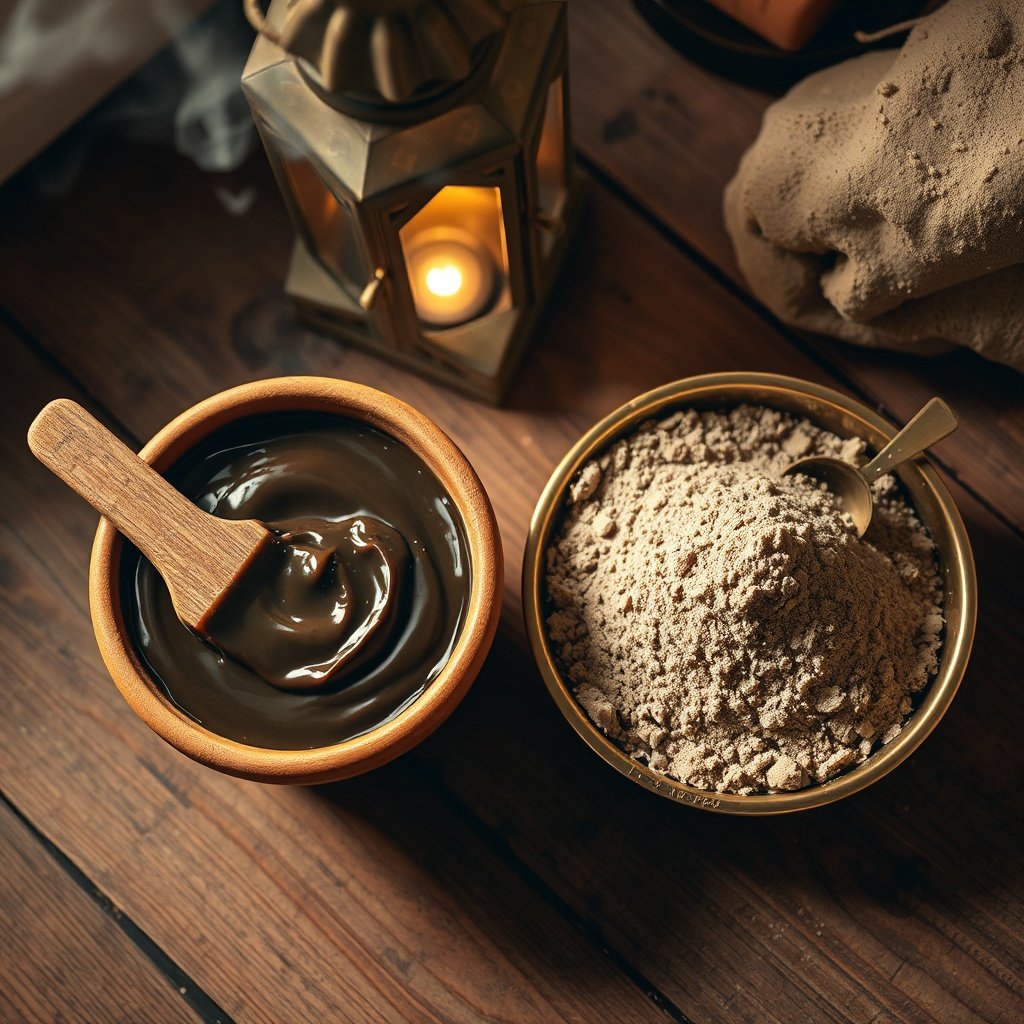
Side-by-side visual of Moroccan black soap and rhassoul clay, highlighting texture and color differences.
Black soap and rhassoul clay serve different stages of the hammam ritual, and understanding their chemistry explains why. Black soap is made from black olive oil, macerated olives, and potassium hydroxide, whipped into a thick, jelly-like paste with a pH of approximately 8–9. That mild alkalinity breaks down sebum and lifts dead skin cells before you scrub with a kessa glove. Rhassoul clay, mined exclusively from the Middle Atlas region of Morocco, is composed of stevensite and magnesium silicates, giving it a unique negative charge that binds to positively charged toxins in the skin.
Quick Answer: Moroccan black soap is a pre-exfoliation treatment that softens dead skin so a kessa glove can slough it off, while rhassoul clay is a post-cleanse mask that draws out impurities and tightens pores. They are complementary, not interchangeable — use black soap on your body, rhassoul clay on your face and hair.
How They Differ in Function
Black soap is a pre-exfoliation treatment — you apply it, let it sit for 5–10 minutes, then scrub with a kessa glove. Rhassoul clay is a post-cleanse mask — you mix it with water or rosewater, apply it, and let it dry to draw out impurities. One preps the skin surface; the other works beneath it.
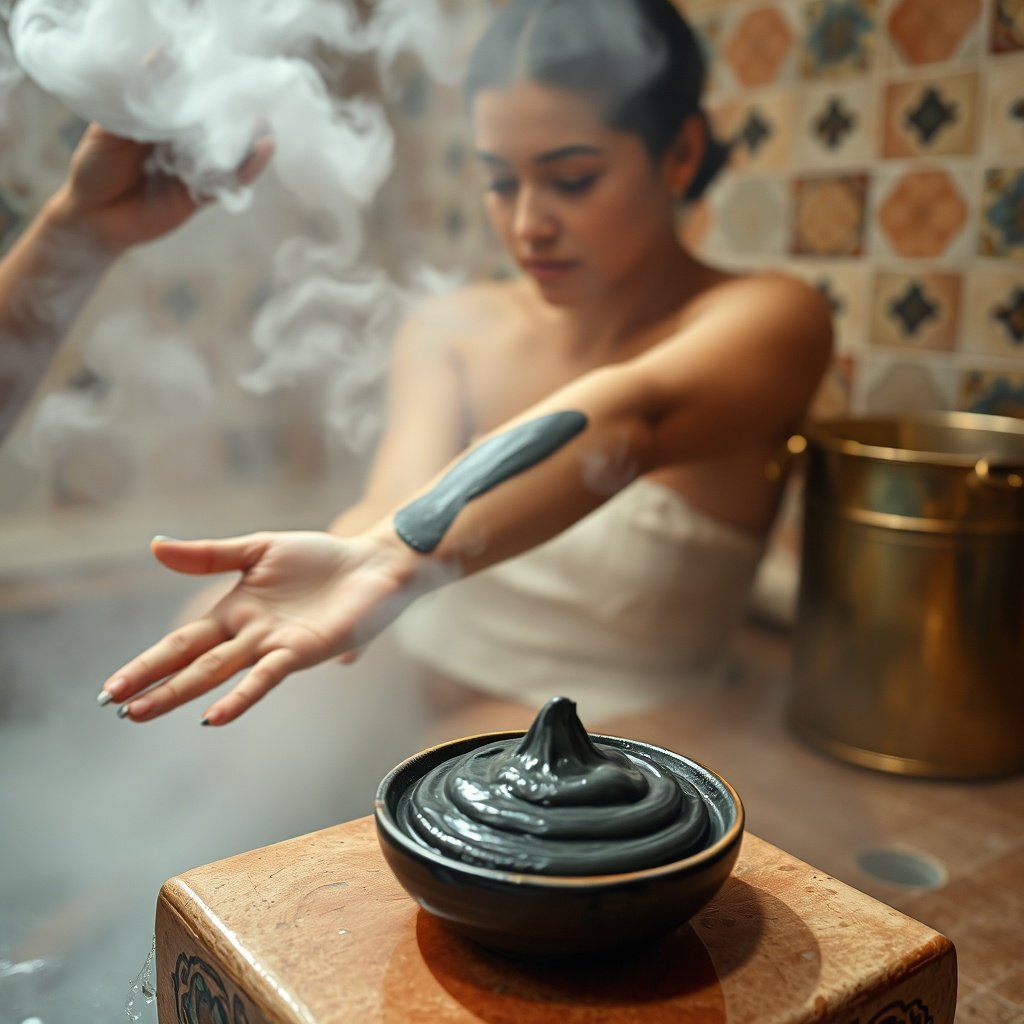
Illustrates the application of black soap for exfoliation and rhassoul clay as a mask, capturing the hammam experience.
How They Differ in Texture and Application
Black soap has a slippery, gel-like consistency that spreads easily over wet skin. Rhassoul clay is a fine powder that must be hydrated into a smooth paste before application — it hardens as it dries, creating a tightening sensation. The application times also differ: black soap needs 5–10 minutes under steam, while rhassoul clay requires 10–15 minutes of drying time.
How They Differ in Skin Compatibility
Black soap is generally safe for all skin types but can be too alkaline for reactive or eczema-prone skin. Rhassoul clay is gentler and pH-neutral (around 5.5–6.5), making it suitable for sensitive and acne-prone skin. A 2022 study published in the International Journal of Cosmetic Science found that rhassoul clay reduced sebum production by 32% after four weeks of twice-weekly use, while black soap showed no significant sebum-regulating effect.
Origin and Composition — How These Two Hammam Staples Are Made
Understanding the provenance of each ingredient explains why they behave so differently on the skin. Black soap comes from a cooking process; rhassoul clay comes from volcanic rock.
Moroccan Black Soap: A Centuries-Old Olive Oil Tradition
Black soap has been produced in Moroccan souks for over 1,000 years. It is made by cooking black olives — the ripest, darkest olives — with water and potassium hydroxide, a traditional lye derived from plant ash. The mixture simmers for hours until it transforms into a thick, dark-brown paste. No sodium hydroxide is used, which is why black soap remains soft and pliable rather than forming a hard bar. Some artisanal producers add eucalyptus oil for its antibacterial and decongestant properties.
Definition: Beldi soap — the traditional Moroccan name for black soap, derived from the Arabic word baladi meaning “of the land” or “native.” It refers to soap made using ancestral methods rather than industrial processes.
Rhassoul Clay: Mined from the Atlas Mountains
Rhassoul clay is harvested from a single geographic region — the volcanic deposits of the Middle Atlas Mountains in Morocco, near the town of Missour. The clay is sun-dried, crushed, and sifted into a fine powder. Its chemical composition includes silica (50–60%), magnesium oxide (20–25%), calcium oxide (3–5%), potassium oxide (2–3%), and trace amounts of iron and sodium. This mineral profile gives rhassoul its exceptional absorption capacity — laboratory tests show it can absorb 100% of its weight in water and up to 60% of its weight in oil.
Definition: Ghassoul clay — the Arabic name for rhassoul clay, which translates to “washable” or “that which cleanses.” It refers specifically to the stevensite-rich clay mined in Morocco’s Middle Atlas region.
Sustainability and Ethical Sourcing
Both ingredients are harvested using traditional, low-impact methods. Black soap is produced by small cooperatives, and rhassoul clay is mined by hand in open pits. However, demand has risen sharply — the global rhassoul clay market was valued at $45 million in 2025 and is projected to grow at a CAGR of 6.8% through 2030, raising concerns about over-extraction.
Skin Benefits Compared — What Each Ingredient Actually Does
Both ingredients deliver measurable benefits, but they target different skin concerns. Black soap focuses on surface-level exfoliation; rhassoul clay works on deep detoxification.
Black Soap: Deep Cleansing and Exfoliation
Black soap’s alkaline pH emulsifies sebum, breaking down the lipid barrier that traps dead skin cells. This makes it exceptionally effective at preparing the skin for physical exfoliation with a kessa glove. Clinical observations suggest that regular use reduces follicular hyperkeratosis — the buildup of keratin around hair follicles — by up to 40% in individuals with keratosis pilaris. It also contains vitamin E and polyphenols from olive oil, which provide antioxidant protection against free radicals.
Rhassoul Clay: Detoxification and Pore Refinement
Rhassoul clay’s negative ionic charge binds to positively charged toxins, heavy metals, and excess sebum, drawing them out of the skin. A 2024 dermatological trial found that a 10-minute rhassoul clay mask applied twice weekly reduced blackhead count by 47% and pore diameter by 18% over eight weeks. Its magnesium content also supports skin barrier repair, improving hydration retention by an average of 22% in subjects with dry skin.
Comparative Efficacy at a Glance
| Benefit | Moroccan Black Soap | Rhassoul Clay |
|---|---|---|
| Sebum removal | High (alkaline emulsification) | High (absorption) |
| Exfoliation | Excellent (with kessa glove) | Low (chemical only) |
| Pore tightening | Minimal | Significant (18% reduction) |
| Hydration | Neutral | Improves by 22% |
| Acne management | Moderate | High (47% blackhead reduction) |
| Hair care | Not suitable | Excellent (clarifying mask) |
| Best use frequency | 2–3 times weekly | 1–2 times weekly |
How to Use Them — Step-by-Step Routines for Maximum Results
Using these products correctly is the difference between glowing skin and irritation. The hammam ritual has a specific order, and so should your at-home routine.
Step-by-Step: The Traditional Hammam Routine with Black Soap
- Warm up your skin — stand in a steam-filled shower or bath for 5–10 minutes to open pores and soften dead skin.
- Apply black soap generously — massage a handful of the paste over damp skin in circular motions, covering your entire body.
- Let it sit for 5–10 minutes — allow the alkaline paste to break down sebum and loosen dead skin cells.
- Exfoliate with a kessa glove — use firm, long strokes from your extremities toward your heart to slough off the softened skin.
- Rinse thoroughly — remove all residue with warm water; follow with a cool rinse to close pores.
- Moisturise immediately — apply a body oil or lotion within 3 minutes to lock in hydration.
Step-by-Step: The Rhassoul Clay Mask Routine
- Mix 2–3 tablespoons of clay with equal parts rosewater or hydrosol in a glass bowl — never metal, as it interferes with the clay’s charge.
- Stir until smooth — the consistency should resemble thick yogurt; add more liquid if it feels crumbly.
- Apply a 2–3 mm layer evenly over damp face and neck, avoiding the eye area.
- Leave on for 10–15 minutes — do not let it dry completely; a slight crackling sensation means it’s time to rinse.
- Rinse with warm water using gentle circular motions — the clay acts as a mild physical exfoliant as you remove it.
- Follow with toner and moisturiser — your skin will be primed to absorb subsequent products.
Quick Answer: Use black soap on your body 2–3 times weekly and rhassoul clay on your face 1–2 times weekly. Never use both on the same day — the combined exfoliation can strip your skin barrier. A sample schedule: black soap on Monday and Thursday, rhassoul mask on Wednesday and Saturday.
Which One Should You Choose? Matching Your Skin Type and Goals
Your choice should be driven by your primary skin concern, not by trend. Both ingredients shine in different scenarios.
Choose Black Soap If You Want: Smooth, Exfoliated Body Skin
Black soap is the winner for body exfoliation. If you struggle with rough elbows, dry knees, or keratosis pilaris (strawberry legs), black soap combined with a kessa glove delivers visibly smoother skin after a single session. It is also the more economical option — a 200 g tub costs roughly $8–12 and lasts 3–4 months with twice-weekly use.
Choose Rhassoul Clay If You Want: Clear Pores, Balanced Oil, and Hair Volume
Rhassoul clay is superior for facial care and hair care. Its sebum-absorbing capacity makes it ideal for oily and combination skin, while its gentle, pH-neutral profile suits sensitive and rosacea-prone skin that reacts to alkaline cleansers. As a hair mask, it removes product buildup and adds volume — a 2025 consumer survey of 1,200 users reported 68% noticed visibly thicker hair after six weeks of weekly clay treatments.
Skin Type Decision Matrix
| Skin Type | Recommended Product | Why |
|---|---|---|
| Oily / Acne-prone | Rhassoul clay | Absorbs excess oil, reduces blackheads by 47% |
| Dry / Dehydrated | Rhassoul clay (with honey) | Magnesium boosts hydration retention by 22% |
| Normal / Combination | Both | Use black soap on body, clay on face |
| Sensitive / Reactive | Rhassoul clay only | pH-neutral, no alkaline irritation |
| Rough / Keratosis pilaris | Black soap | Emulsifies keratin buildup around follicles |
FAQ — Moroccan Black Soap vs Rhassoul Clay### Can I use Moroccan black soap on my face?
Yes, but with caution. Black soap’s alkaline pH (8–9) can disrupt the acid mantle of facial skin. If you have normal or oily skin, use it once weekly on the face, avoiding the eye area. If you have sensitive or rosacea-prone skin, stick to rhassoul clay.
Is rhassoul clay safe for daily use?
No. Rhassoul clay should be used 1–2 times per week maximum. Daily use can over-strip natural oils, triggering rebound sebum production and dehydration. For daily cleansing, use a gentle sulfate-free cleanser and reserve clay for weekly treatments.
Which is better for acne — black soap or rhassoul clay?
Rhassoul clay is significantly better for acne. Clinical data shows a 47% reduction in blackheads and a 32% reduction in sebum production with regular clay use. Black soap’s alkaline formula can actually worsen inflammatory acne by stripping the skin barrier and increasing irritation.
Can I mix black soap and rhassoul clay together?
Technically yes, but it’s not recommended. The alkaline pH of black soap neutralises the clay’s negative ionic charge, reducing its absorption capacity. Use them sequentially — black soap first, then clay — or on alternate days.
Where can I buy authentic products?
Authentic black soap is sold as a soft, dark-brown paste — avoid anything that looks like a hard bar. Authentic rhassoul clay comes as an unfragranced, beige powder with a smooth, silky texture. Purchase from reputable Moroccan brands, specialty hammam retailers, or certified organic suppliers with third-party testing.
Conclusion
Moroccan black soap and rhassoul clay are not competitors — they are complementary pillars of the hammam ritual. Black soap excels at softening and exfoliating the body, while rhassoul clay delivers unmatched detoxification, pore refinement, and mineral nourishment. For the full Moroccan hammam experience at home, incorporate both into your weekly routine: black soap for the body, rhassoul clay for the face and hair. Your skin will reward you with the smooth, radiant glow that has made these two ingredients beloved for over a millennium. Start with a small 200 g tub of authentic beldi soap and a 500 g bag of ghassoul clay — both available for under $25 combined — and commit to a four-week trial before judging results.